

The luxury property Malaysia 2026 enters the year on a firmer footing after several years of adjustment. Buyer confidence improved in 2025, supported by affluent locals, returning Malaysians, and foreign high-net-worth individuals.
With the economy stabilising and significant infrastructure projects progressing, the luxury segment is set for steady growth. Unlike the general high-rise market, which faces oversupply in certain areas, luxury buyers prioritise long-term value, lifestyle quality, and prestige.
This is driving stronger demand for ultra-prime homes and branded residences. With clearer government direction and continued global interest, 2026 is shaping up to be a promising year for luxury property purchasers.
Invest in Malaysia’s Fast-Growing Luxury Market
Discover exclusive residences designed for comfort, prestige, and long-term value.
What Will Drive Luxury Property Demand In 2026
Several structural and economic factors are expected to influence the demand for luxury property in Malaysia in 2026. Rising wealth levels, clearer Government policies, and stable economic conditions are strengthening confidence among affluent local buyers and foreign investors.
At the same time, well-connected developments near key expressways, transport lines, and commercial districts continue to shape purchasing decisions in the high-end segment.
- Growth Of High-Net-Worth Individuals In 2026
The population of high-net-worth individuals (HNWIs) in Malaysia is rising. The real estate consultancy firm Knight Frank identifies that growing wealth in Malaysia is reshaping demand for luxury homes and prime properties.
This wealth expansion is part of a global trend: HNWI growth worldwide rose about 4.4 per cent in the prior year, and Asia contributed significantly.
As affluent individuals and buyers diversify their portfolios, many are inclined to invest in luxury residential properties, especially in well-connected cities such as Kuala Lumpur, or high-potential areas like Penang and Johor Bahru.
Because luxury real estate appeals to high-net-worth demographics, this structural wealth growth remains a strong long-term demand driver.
- 2026 Government Measures And Policy Updates
Malaysia’s broader real estate sector, not just luxury, saw steady growth in 1H 2025, supported by investments in infrastructure and data centres and resilient domestic demand.
This indicates supportive economic and policy conditions that may also benefit the luxury segment, especially as infrastructure and urban development create improved living and connectivity environments.
- 2026 Economic Outlook And Its Influence On Buyer Confidence
Malaysia’s real estate market demonstrated resilience amid global uncertainty, suggesting domestic demand, including for premium segments, remains stable.
The industrial, office, retail, and hospitality sectors recorded healthy activity, indicating a diversified real estate environment beyond residential alone.
A stable macroeconomic environment, with diversified economic engines across states (not only Kuala Lumpur), offers a foundation for luxury property demand, especially among long-term investors and expatriates seeking stable residences or rental homes.
Key Luxury Property Trends To Watch In 2026
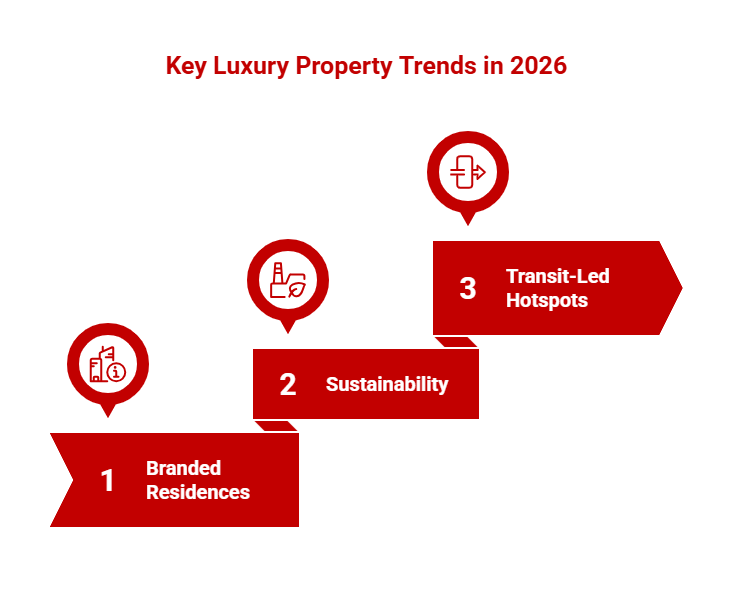
The luxury market in 2026 will be shaped by evolving lifestyle expectations and long-term value considerations. Buyers are looking for homes with modern layouts, stronger privacy, integrated technology, and sustainability features. Developers are responding by offering branded residences, curated facilities, and better management standards, which differentiate premium projects from older high-rise stock.
- Branded Residences And Ultra-Prime Homes Leading 2026 Demand
A shift has been observed: buyers are prioritising properties that are not only well located but well managed, with a preference for convenience and quality over speculative gains.
According to Knight Frank’s evaluation of Kuala Lumpur’s prime property market, demand remains selective, with growing interest in high-quality residential real estate.
As a result, branded residences or ultra-prime buildings offering strong amenities, services, and long-term value are likely to stand out in 2026.
- Sustainability And Smart-Living As 2026 Baseline Expectations
While none of the sources specifically quantify “smart-living” trends, the general shift in investor preferences noted by Knight Frank towards long-term fundamentals, quality management, and modern living standards supports the idea that sustainability and build quality will matter more to luxury buyers.
Given global real estate trends and rising awareness among HNWIs, it is logical to expect that environmentally conscious developments or those offering modern amenities will attract more substantial interest in 2026.
- Integrated Transit-Led Luxury Hotspots In 2026
Recent data shows that while some residential segments are oversupplied, particularly high-rise condominiums, demand persists in locations with stronger fundamentals, connectivity, and access to infrastructure.
Developments close to major expressways, economic zones, or within well-connected cities tend to stay more resilient. Given Malaysia’s urban structure and ongoing infrastructure development, it is plausible that such transit-oriented, well-located luxury homes will remain in demand.
Price And Rental Outlook For Luxury Homes In 2026
Luxury residential prices are expected to remain stable to moderately positive in 2026, supported by low supply in premium locations and steady interest from both own-stay buyers and investors. Rental demand is likely to stay resilient, especially in areas favoured by expatriates and multinational companies. Well-located units with quality facilities, modern upgrades and strong management tend to command higher rents and lower vacancy rates.
- 2026 Price Movement Across Major Luxury Districts
Data from 1Q 2025 shows that Kuala Lumpur’s prime property market, defined as the top 5% of housing, recorded a modest 0.2% year-on-year increase globally.
This suggests that, while growth is being measured, the luxury segment has remained stable despite broader market headwinds.
At the same time, regional markets like Johor and Penang have shown relative strength compared with the broader high-rise glut in Kuala Lumpur, suggesting that demand and pricing dynamics may diverge across regions in 2026.
Therefore, in well-positioned districts and in regional cities, price appreciation or at least value preservation is plausible in 2026, primarily for premium, well-managed properties.
- 2026 Rental Demand Among Expatriates And Corporates
Given growing interest from wealthy investors and expatriates, demand for high-end rentals remains promising. Knight Frank and other observers point to steady demand for prime residences in Malaysia’s top cities.
As companies expand operations inland or regionally and interest in flexibility rises, rental housing in luxury segments may be preferred over purchase, particularly among expatriates and corporate transferees.
This trend may give luxury landlords a stable income stream and reinforce long-term investor confidence in 2026.
- 2026 Supply Pipeline And Its Pressure On Prices
Recent reports highlight a pronounced oversupply issue in specific condominium segments, especially mid- to high-rise units in urban areas.
One report notes that unsold residential units have increased, and absorption rates have declined, signalling a mismatch between supply and demand in those segments.
However, the luxury segment, which tends to favour lower-density, high-quality, well-managed developments, appears less affected by this oversupply, as demand remains selective and quality-driven.
If developers remain disciplined and focus on quality over quantity, the 2026 supply may be manageable, which supports stable luxury-home pricing and value retention.
Luxury Hotspots To Watch Across Malaysia In 2026
Several urban and lifestyle-driven locations are expected to lead luxury property interest in 2026. Greater Kuala Lumpur remains the market anchor, while Penang Island offers coastal living and cultural appeal. Johor Bahru continues to benefit from cross-border activity with Singapore, and emerging areas in Langkawi and Kota Kinabalu attract buyers seeking premium leisure homes.
- Greater Kuala Lumpur In 2026: KLCC, Bukit Bintang, TRX, Mont Kiara
Kuala Lumpur remains the flagship city for luxury real estate, especially in well-established districts where demand for high-end living persists. Knight Frank’s 2025 assessment highlighted continued interest in quality residential properties, especially those that meet evolving lifestyle expectations.
Although the broader condominium market faces softness, the top-tier segment continues to attract discerning buyers who value location, accessibility, and building quality.
Therefore, luxury developments in central districts or near key transport and infrastructure links remain relevant for 2026 buyers.
- Penang Island In 2026: Tanjung Tokong, Gurney Drive, George Town
Penang is increasingly viewed as a viable alternative to Kuala Lumpur for luxury property investment, partly due to rising interest from both domestic and regional investors in coastal and heritage-rich districts.
As the industrial and hospitality sectors grow in the state, demand for high-quality residential space may increase, particularly among corporate expatriates and families seeking a balance between lifestyle and convenience.
For 2026, seafront and well-located high-end residences in Penang could therefore offer a compelling value proposition combining relative affordability with lifestyle and long-term value potential.
- Johor Bahru–Singapore Corridor In 2026: Iskandar Puteri And Beyond
Johor’s property market has been buoyed by spillover demand and interest from Singaporeans, especially for properties near economic corridors or cross-border zones. Reports note that Johor continues to “sizzle” even as other markets cool.
The promise of the Johor–Singapore Special Economic Zone, improved transport connectivity such as the RTS Link, and cross-border mobility support sustained interest in premium residences in Iskandar Puteri and surrounding precincts.
For investors seeking value compared with core city prices, this corridor remains attractive heading into 2026.
- Emerging 2026 Lifestyle Markets: Langkawi And Kota Kinabalu
While coverage is limited for these secondary or tourism-linked markets, general shifts in investor preferences towards lifestyle, wellness, and getaway homes create potential for growth beyond traditional urban hotspots.
As infrastructure and tourism initiatives continue, demand for quality residential or resort-style homes could broaden the scope of luxury real estate beyond main cities.
Plan Your Luxury Home Purchase Smartly
Estimate your monthly payments before you buy.
What These 2026 Trends Mean For Buyers
For buyers, 2026 will be a year that rewards careful selection and long-term planning. Properties with strong fundamentals, good connectivity, sustainable design and quality maintenance are expected to hold value better.
Different buyer groups, such as local upgraders, returning Malaysians, and foreign investors, will need to align their choices with their lifestyle needs, rental goals, or long-term ownership plans.
- For Local Upgraders In 2026
Affluent Malaysians upgrading to luxury homes in 2026 should prioritise properties with fundamentals: good location, building quality, modern design, and long-term value over speculative short-term gains.
Given selective demand in the luxury segment and oversupply in the mass high-rise market, discerning buyers can secure value, especially if they choose well-managed or branded residences.
Consideration of long-term maintenance costs, service charges, and overall property sustainability will matter more than mere location, especially given rising costs and market sensitivity.
- For Foreign Investors Entering Malaysia In 2026
Foreign investors may find Malaysia’s luxury market attractive thanks to relatively competitive pricing, stable demand among wealthy locals, and a growing class of HNWIs seeking quality residences.
Given global wealth trends and cross-border mobility, properties offering flexibility (rental potential, branded residences, serviced homes) may appeal more than speculative investments.
Long-term perspective and careful selection (location, management quality, connectivity) will remain key to maximising value.
- For Returning Malaysians And Regional Buyers In 2026
Returning Malaysians or regional buyers from more expensive cities may continue to view Malaysia’s luxury real estate as offering favourable value, especially in regional or secondary cities where lifestyle and affordability balance well.
As global mobility and hybrid living increase, properties offering comfort, convenience, and long-term value may hold appeal over pure investment returns in the near term.
Risks And Factors To Consider In 2026
In 2026, developers are prioritising low-density layouts, wellness-focused amenities, and stronger building management to meet the expectations of luxury buyers. Smart-home features, energy-efficient systems, and hotel-style services are becoming common.
With growing competition, design quality, branding, and long-term liveability are now essential to the success of luxury developments.
- Oversupply Risks In Select High-Rise Corridors
Recent data suggests that Malaysia’s property market continues to experience oversupply, particularly in high-rise condominiums in major urban centres.
Unsold inventory appears to remain high, and absorption rates have declined, signs that demand may not be keeping pace with supply in specific segments.
However, oversupply seems to be concentrated in subprime and mid-market segments rather than in premium or ultra-prime residences.
Buyers must therefore exercise discernment, focusing on location, building specification, and long-term viability rather than just price or availability.
- Service Charges, Construction Costs, And 2026 Pricing
While there is no comprehensive public data yet that isolates luxury developments’ service charges or cost inflation for 2026, general market commentary suggests rising construction and maintenance costs.
For luxury buyers, this means factoring in long-term occupancy costs (service charges, maintenance, facilities upkeep) when calculating the total cost of ownership.
- Global Market And Currency Sensitivity In 2026
Luxury property demand, especially from foreign buyers, remains sensitive to global economic conditions, financial markets, and currency fluctuations. Given global uncertainty, this remains a risk factor for 2026.
Local buyers may be more insulated, but foreign-investor appetite could shift if global investor sentiment changes or if currency volatility increases.
How Developers Will Shift Strategies In 2026
Developers are expected to refine their approaches in 2026 by emphasising low-density layouts, wellness-oriented amenities, and better building management. Many are integrating smart-home features, energy-efficient systems, and hospitality-style services to cater to affluent buyers.
As competition intensifies, design quality, branding, and long-term liveability are becoming essential pillars of luxury project planning.
- 2026 Design Trends In Luxury Developments
According to Knight Frank’s assessment, buyers are increasingly selective, favouring high-quality, well-managed properties over high-volume units.
This suggests developers may pivot towards low-density towers, premium finishes, and lifestyle-driven floor plans to meet buyer expectations.
Smart-living features, better amenities, and design coherence will likely become more standard among luxury developments seeking to attract discerning buyers.
- Transit And Infrastructure Integration In 2026 Projects
Connectivity remains a strong determinant of value. As supply softens in some segments, properties near major expressways or transport corridors are likely to hold their value better, especially for buyers prioritising convenience and accessibility.
Developments positioned near well-connected zones or economic corridors, whether in Greater Kuala Lumpur, Johor, or Penang, are likely to fare better in 2026 than isolated or poorly connected options.
- Hospitality Partnerships And Branded Concepts In 2026
While detailed data on branded-residence uptake remains limited, the noted trend of HNWI demand and preference for high-quality managed homes suggests that hospitality-linked or managed residences may gain popularity among investors and expatriates.
For developers, this may translate into more collaborations with lifestyle or hotel brands to deliver serviced luxury homes, which may appeal especially to foreign buyers and those seeking hassle-free ownership.
What To Expect From Malaysia’s Luxury Property Market In 2026
The luxury property market in Malaysia appears well-positioned for selective, quality-driven growth in 2026. Rising wealth among HNWIs, stable macroeconomic conditions, and evolving buyer preferences, including demand for well-managed, connected, modern homes, underpin this outlook.
Regions such as Greater Kuala Lumpur, Penang Island, and the Johor Bahru–Singapore corridor emerge as likely hotspots for value retention or appreciation, especially for well-located, premium-quality residences.
Yet, oversupply in specific high-rise segments, rising costs, and global economic uncertainty remain risks. Buyers and investors must remain selective, focus on long-term fundamentals, and view luxury property as a long-term commitment rather than a short-term speculation.
For those who choose wisely, 2026 could well be a strategic entry point into Malaysia’s luxury property market, balancing lifestyle, quality, and potential long-term value.
For deeper insights on buying, budgeting, and market trends, explore the full range of PropertyGuru Guides to help you plan with confidence.
Ready to start your search? Explore Malaysia’s exclusive homes for sale and find a property that fits your needs.
Disclaimer: The information is provided for general information only. PropertyGuru International (Malaysia) Sdn Bhd makes no representations or warranties in relation to the information, including but not limited to any representation or warranty as to the fitness for any particular purpose of the information to the fullest extent permitted by law. While every effort has been made to ensure that the information provided in this article is accurate, reliable, and complete as of the time of writing, the information provided in this article should not be relied upon to make any financial, investment, real estate or legal decisions. Additionally, the information should not substitute advice from a trained professional who can take into account your personal facts and circumstances, and we accept no liability if you use the information to form decisions.