


Malaysia enters 2026 with a stable economic and policy outlook, creating a supportive environment for commercial real estate growth. According to the 2025 market outlook by CBRE/WTW, financial conditions remain healthy, driven by resilient trade, manageable inflation, and steady investor confidence. These fundamentals set a strong foundation for key commercial property trends in Malaysia 2026, particularly across the office and retail sectors.
As businesses continue to adapt to post-pandemic norms, hybrid working models have become more entrenched, influencing how companies think about office space. On the retail side, rising consumer confidence supported by improved employment and domestic spending, plus incoming tourism and infrastructure improvements, is reviving demand for retail and mixed-use spaces.
Meanwhile, policy tailwinds from Budget 2026 under the MADANI Economy framework have emphasised strategic allocations to infrastructure and supportive measures for commercial property, signalling a conducive environment for property development and investment.
Looking To Invest In Malaysia’s Commercial Market?
Explore Grade A offices, neighbourhood retail units and shoplots in high-demand growth areas.
Office Market Trends In Malaysia 2026
Malaysia’s office market in 2026 is shaped by firms settling into long-term hybrid working, which has shifted demand towards flexible, efficient, and well-amenitised workplaces. Grade A and ESG-compliant buildings continue to outperform as companies prioritise sustainability, operational savings, and better employee environments.
Decentralised office hubs such as Petaling Jaya, Bangsar South, and Cyberjaya are also gaining traction, supported by lower rents and improving connectivity. Although new supply keeps vacancy levels elevated in some areas, demand is gradually stabilising as more businesses expand or consolidate into higher-quality, well-located spaces.
- The Hybrid Workplace Settles: What Tenants Now Expect In 2026
Post-COVID, many companies trialled hybrid and remote working. As 2026 approaches, many have now finalised longer-term hybrid arrangements. This evolution is shaping demand profiles: companies are no longer simply looking for “big office floors,” but for flexible, fitted, and amenity-rich spaces.
Facilities such as wellness lounges, high-speed digital connectivity, and good “end-of-trip” amenities (locker rooms, showers, secure bike racks, etc.) are increasingly in demand.
This shift benefits modern office developments, especially Grade A towers, and squeezes demand for older, outdated blocks lacking amenity or efficiency, a trend that will become more pronounced through 2026.
- Flight To Quality: Grade A And ESG-Certified Offices Lead Demand
Investors and occupiers are increasingly preferring offices that meet high standards: energy efficiency, sustainability credentials, and green certifications. According to a detailed market forecast by Mordor Intelligence, flight-to-quality demand, especially for Grade A and green-certified offices, is a key driver of commercial real estate growth through 2030.
In practice, this means that newer developments, particularly those with ESG credentials, are likely to attract stronger tenant interest and command higher rents than older “brown” buildings.
For landlords, retrofitting or redevelopment to meet green standards may become a worthwhile investment as tenant expectations evolve.
- Decentralisation: Growth in Fringe and Suburban Office Nodes
While Kuala Lumpur remains the primary corporate hub, the decentralisation trend continues to gain traction. Suburban and fringe office nodes such as Petaling Jaya, Subang Jaya, Cyberjaya, and other areas in the Klang Valley are seeing increasing demand. Drivers include lower rents compared with central Kuala Lumpur, improved accessibility, and growing suburban residential populations.
In some cases, improved infrastructure, including expressways and enhanced connectivity, supports this shift. As companies balance cost and convenience, suburban offices offer a strategic alternative for SMEs and mid-sized firms. This trend is likely to strengthen in 2026 as firms look to optimise costs while adapting to hybrid working models.
- Supply Pipeline and Vacancy Levels Heading Into 2026
According to the 2025 report by CBRE/WTW, Malaysia’s commercial real estate sector remains robust, with offices still accounting for a significant share of the market.
That said, the market is entering 2026 with mixed conditions. While demand for quality office space is rising, portions of the existing office stock, especially older, less efficient buildings, continue to face oversupply or slower absorption.
Landlords willing to retrofit or reposition their properties (e.g., upgrading facilities, improving energy efficiency, offering flexible lease terms) stand to benefit. Meanwhile, speculative office developments in fringe areas without clear demand or transport links may struggle unless carefully targeted.
Retail Property Trends In Malaysia 2026
Malaysia’s retail sector enters 2026 with a steady recovery, driven by improving consumer confidence, rising tourism activity, and ongoing mall repositioning efforts. Retailers are embracing omni-channel strategies, blending online convenience with physical store experiences, which is increasing demand for flexible layouts and logistics-friendly malls.
Experiential retail, including F&B, entertainment and wellness, continues to outperform traditional retail segments, supporting footfall in well-managed centres. Neighbourhood malls remain resilient, benefiting from daily-needs spending and dense suburban populations.
While competition among malls intensifies, those offering a potent tenant mix, modern upgrades and accessible locations are expected to lead the market in 2026.
- Experiential Retail Strengthens Mall Performance
The retail landscape in Malaysia is transforming. According to the mid-year review by Raine & Horne, the retail (shopping complex) sector showed steady recovery between 2024 and 2025, with improving occupancy and stabilising rentals.
Malls and shopping complexes are repositioning themselves: moving away from purely retail-heavy tenant mixes and embracing experiential and lifestyle tenants such as F&B outlets, entertainment, wellness, and leisure services.
This reflects changing consumer preferences: shoppers now value experiences and social spaces as much as retail products.
Such repositioning is likely to continue in 2026. Malls that offer a mix of retail, food and beverage, entertainment, socialising and convenience will become more resilient. Those that remain anchored on old retail-only models without evolution may face declining footfall and tenant churn.
- The Rise of Omni-Channel Retail: How Online and Offline Integrate in 2026
E-commerce and online shopping have boomed in recent years. Instead of killing physical retail, this shift has prompted many retailers to embrace an omni-channel approach, combining online and physical presence to give consumers flexibility (e.g., click-and-collect, online ordering, in-store pick-up, integrated logistics).
This hybrid retail model influences demand for retail units: developers and landlords are adapting layout planning to include storage & fulfilment areas, click-and-collect counters, and flexible spaces.
As a result, malls and retail centres with strong logistics connectivity and flexible, leaseable layouts are likely to attract more omnichannel retailers, a trend expected to deepen in 2026.
Neighbourhood malls and community-based retail also benefit from convenience and accessibility, these hubs align well with day-to-day consumer needs, frequent shorter visits, and online–offline hybrid shopping habits.
- Tourism-Led Retail Recovery In Key Cities
As domestic spending strengthens and international tourism returns, retail in tourist-heavy zones and major cities stands to benefit. Analysts have noted that with government support and economic recovery, tourism-linked retail and hospitality demand will rise.
Key, tourism-driven precincts such as Kuala Lumpur, Penang, Johor Bahru, and other gateway cities could see growth in lifestyle retail, duty-free shopping, hospitality-retail hybrids, and leisure-oriented tenants. This revival is particularly likely with improved transport connectivity and infrastructure, which will encourage both domestic and international visitors.
- Neighbourhood And Community Malls Remain Resilient
While large regional malls often dominate headlines, a strong case remains for smaller, community- or neighbourhood-level retail centres. As household consumption patterns shift and people favour convenience, these smaller malls serving daily needs like groceries, pharmacies, F&B, clinics, and basic services show resilience.
In 2026, as more Malaysians live and work outside city centres, such community malls offer stable footfall, lower rental commitments and are attractive to small businesses, SMEs, and local entrepreneurs looking for accessible retail or service space.
Location Highlights: Commercial Hotspots To Watch in 2026
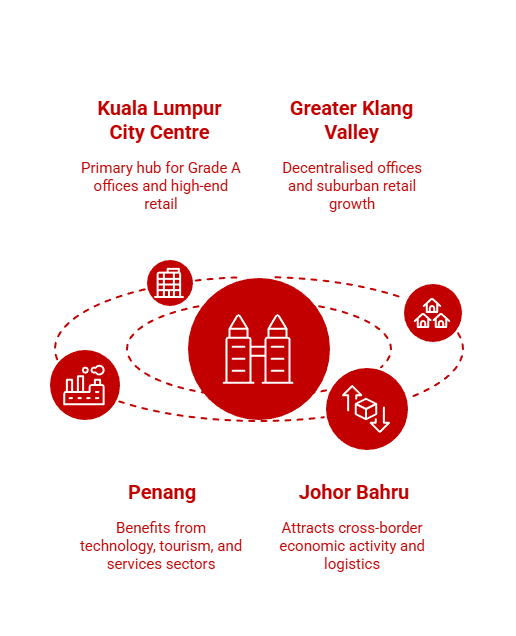
In 2026, commercial activity in Malaysia is expected to remain concentrated in Kuala Lumpur City Centre, supported by demand for Grade A offices and the opening of new lifestyle-driven retail spaces. Greater Klang Valley locations such as Petaling Jaya, Bangsar South and Subang Jaya are strengthening as decentralised hubs, offering cost-efficient offices and resilient neighbourhood retail.
Penang continues to attract commercial demand from its technology, tourism and services sectors, while Johor Bahru benefits from cross-border economic activity and improving regional connectivity. These nodes are likely to draw investors and occupiers seeking growth potential, accessibility and well-managed commercial environments.
- Kuala Lumpur City Centre (KLCC) & Core Kuala Lumpur
Kuala Lumpur remains the primary hub for Grade A offices, corporate headquarters, and high-end retail. The continued demand for premium office space, particularly green-certified, centrally located towers, ensures KL remains a key node.
On the retail front, developments such as Ombak KLCC, slated for opening in 2026 with a net lettable area of about 420,000 sq ft, add fresh supply to KL’s retail ecosystem.
Meanwhile, the upcoming 118 Mall at the base of Merdeka 118 Tower is expected to open in 2026, positioning itself as a modern retail-led lifestyle destination.
These landmark developments are likely to attract both local and international tenants, retail brands, and lifestyle operators, reinforcing KL’s status as Malaysia’s commercial heart.
- Greater Klang Valley: Decentralised Offices, Suburban Retail and Mixed-Use Growth
Beyond central KL, the Greater Klang Valley (including Petaling Jaya, Subang Jaya, Cyberjaya, and surrounding suburbs) is seeing growing interest in decentralised offices and community-level retail assets.
Factors favouring this shift include lower rental costs, improving infrastructure, and changing commuter patterns.
For investors or small-to-medium enterprises looking for cost-effective office or retail space, these fringe areas offer viable alternatives to the city centre, especially given the rising demand for flexibility and affordability in 2026.
- Penang
As a long-standing regional commercial hub, Penang is poised to benefit from continued demand for both office and retail. Given its industrial and manufacturing base and a moderate cost structure, Penang could see increased demand for office space from corporates and SMEs. Retail demand may also rise, especially in areas tied to tourism and lifestyle, as domestic and inbound tourism recover.
- Johor Bahru and Southern Corridor
The southern corridor, especially Johor Bahru, remains an attractive commercial growth region, particularly for cross-border logistics and mixed-use developments. As industrial investment, data centre growth and logistics demand increase, there may be a spill-over effect into office and retail markets.
Companies are setting up regional offices, service hubs, and employee accommodation, driving retail and office demand.
Given rising interest and development in the region, investors and occupiers may find opportunities for relatively lower-cost, high-growth potential assets in 2026.
Discover New Commercial Developments Arriving In 2026
Browse top commercial properties for your business today.
Top Commercial Property Types to Watch in Malaysia in 2026
Malaysia’s commercial property market in 2026 is being driven by hybrid working, the rise of experience-focused retail, and the growth of key locations such as KL, Penang, and Johor Bahru. Based on these shifts, here are the commercial property types expected to perform well and offer strong opportunities for businesses and investors.
- Grade A & ESG-Ready Office Towers
Driven by the flight-to-quality trend, modern towers in areas like KLCC, Bangsar South, and TRX continue to outperform older stock. Tenants now prioritise sustainability certifications, energy efficiency, wellness facilities and flexible layouts.
- Decentralised & Suburban Office Hubs
As hybrid working becomes permanent, more companies are shifting towards cost-effective suburban nodes such as Petaling Jaya, Subang Jaya, and Cyberjaya. These areas offer lower rentals, strong connectivity and improved amenities, making them attractive for SMEs and expanding firms.
- Neighbourhood & Community Retail Centres
Neighbourhood malls remain resilient thanks to daily-needs spending and dense suburban catchments. Retail spaces in areas like Kota Damansara, Setia Alam, Cheras, and Penang Mainland continue to draw steady footfall and offer more affordable investment entry points.
- Lifestyle, F&B & Experiential Retail Spaces
Experiential retail F&B, entertainment, wellness, and boutique concepts are outperforming traditional retail. New developments such as Ombak KLCC, 118 Mall, and Sunway Square reflect this shift, offering lifestyle-led tenant mixes and strong brand appeal.
- Mixed-Use Commercial Developments
Integrated developments combining office, retail, hospitality, and residential elements continue to attract businesses looking for convenience and visibility. Areas such as Bukit Bintang City Centre (BBCC), KL Sentral, and Iskandar Puteri offer strong long-term potential with stable tenant demand.
- Shop Offices & Shoplots in Growing Townships
Shoplots remain a favourite for SMEs, local entrepreneurs, and first-time commercial investors. High-growth corridors such as Setapak, Puchong, Shah Alam, Iskandar Malaysia, and Butterworth are seeing sustained demand for ground-floor retail and upper-floor office use.
- Retail-Friendly, Logistics-Integrated Commercial Units
With omni-channel retail becoming the norm, small-format commercial spaces that support last-mile fulfilment, pickup points, and storage are in increasing demand, especially in well-connected locations near major highways and residential hubs.
These property types show where demand is heading in 2026, making it easier for businesses and investors to spot good opportunities in Malaysia’s commercial market.
Investment Outlook for Malaysia’s Commercial Property Market In 2026
According to Mordor Intelligence, as of 2025, the Malaysian commercial real estate market was valued at USD9.56 billion, with a projected compound annual growth rate (CAGR) of approximately 7.65% through 2030.
That suggests meaningful sector growth over the next few years, and 2026 is well placed to capture the early phase of that growth.
Investors looking for stable rental income and long-term capital appreciation may especially find value in:
- Grade A offices with green certification and good connectivity are likely to attract premium tenants.
- Retail properties in high-footfall zones (city centre, tourist hotspots) or neighbourhood-level malls anchored by daily-needs tenants.
- Shoplots or shop offices in growing suburban townships are ideal for SMEs, small businesses or first-time investors seeking exposure without high entry costs.
However, investors should remain selective. Oversupply risk persists, particularly for older office blocks and speculative developments in fringe areas with weak transport links or low tenant demand.
Landlords who proactively retrofit, reposition, or offer flexible lease terms are likely to fare better than those who wait for demand to return on its own.
Key Challenges Facing The Commercial Market In 2026
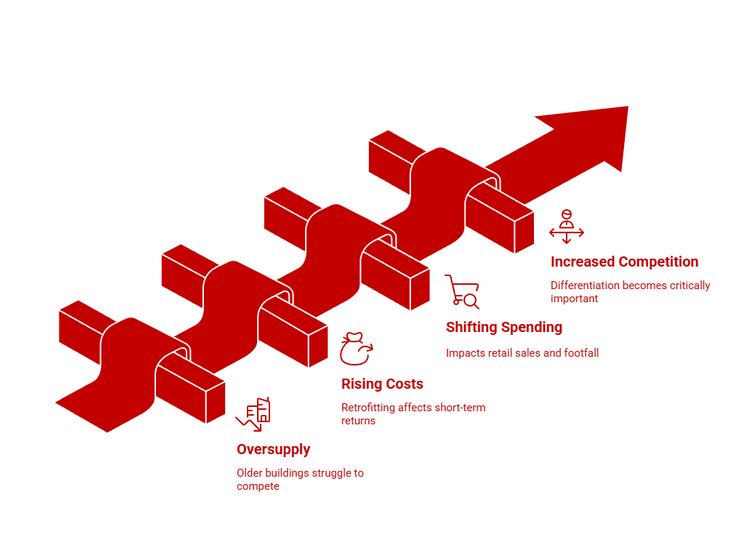
Even with positive momentum, several headwinds warrant attention:
- Oversupply Of Older Office Stock
A portion of the existing office stock, especially older, legacy buildings, may struggle to compete with newer, more efficient, ESG-certified towers. Without upgrades, such buildings may see elevated vacancy or downward pressure on rents. - Rising Operating and Upgrade Costs
For landlords looking to retrofit or redevelop, costs associated with green certification, energy-efficiency improvements, and modern amenities may be substantial, potentially affecting short-term returns. - Shifting Consumer Spending And Retail Patterns
Although retail is recovering, consumer behaviour remains cautious. Rising household debt and changing consumption habits could impact discretionary spending, which in turn affects retail sales, tenant performance and mall footfall. This could challenge malls heavily reliant on fashion, luxury and non-essential retail tenants. - Competition Among Retail Hubs
As more malls, community shopping centres and mixed-use developments emerge across Klang Valley and regional cities, retail landlords will face increased competition. Differentiation, e.g., experience-led offerings, convenience, and a strong F&B or lifestyle mix, will become critical.
The commercial market faces significant challenges, but with strategic adaptation, opportunities for growth remain.
What 2026 Means For Office and Retail Stakeholders
2026 represents a meaningful turning point for Malaysia’s commercial property sector. For occupiers, tenants, landlords and investors, several key trends stand out:
- Office demand will increasingly favour modern, ESG-ready, amenity-rich Grade A spaces; companies adopting hybrid work will seek flexibility and efficiency.
- Retail will evolve: experiential, omni-channel, neighbourhood, and convenience-oriented retail will outperform traditional models.
- Strategic location matters: city centres for premium corporate and lifestyle retail demand; suburban fringes and regional cities for cost-efficient offices and community retail hubs.
- Investors should adopt selectivity, favouring well-positioned, modern, demand-aligned assets and avoiding outdated stock or over-speculative developments without demand or connectivity.
- For landlords, proactive asset management through retrofitting, tenant mix optimisation, flexible leases, and ESG compliance will be the key differentiator.
In sum, 2026 offers a window of opportunity. Those who recognise and adapt to shifting workplace dynamics, retail behaviours, and macroeconomic fundamentals stand to benefit from the next leg of growth in Malaysia’s commercial property market.
What 2026 Means for Malaysia’s Commercial Property Landscape
Malaysia’s commercial property market is entering 2026 with renewed stability and clearer direction across both office and retail segments. Hybrid working has reshaped workplace expectations, driving stronger demand for flexible, sustainable and well-connected office spaces, while older buildings face increasing pressure to upgrade.
In retail, experiential offerings, omni-channel integration and resilient neighbourhood malls continue to underpin performance as consumer behaviour evolves.
Growth in key locations such as Kuala Lumpur, the Greater Klang Valley, Penang, and Johor Bahru reflects the importance of accessibility, modern amenities, and a thoughtful tenant mix. Although challenges such as oversupply and rising operational costs remain, the market’s overall trajectory is anchored by improving sentiment, steady economic expansion and ongoing urban transformation.
For investors, landlords and occupiers, 2026 presents meaningful opportunities for strategic positioning in Malaysia’s evolving commercial landscape.
For more insights on leasing, financing and commercial property strategies, visit the PropertyGuru Guides section.
Keep Track of New Launches
Visit our new launches page to find the new launch project of your dreams and submit an enquiry today.

Disclaimer: The information is provided for general information only. PropertyGuru International (Malaysia) Sdn Bhd makes no representations or warranties in relation to the information, including but not limited to any representation or warranty as to the fitness for any particular purpose of the information to the fullest extent permitted by law. While every effort has been made to ensure that the information provided in this article is accurate, reliable, and complete as of the time of writing, the information provided in this article should not be relied upon to make any financial, investment, real estate or legal decisions. Additionally, the information should not substitute advice from a trained professional who can take into account your personal facts and circumstances, and we accept no liability if you use the information to form decisions.