


In Malaysia’s increasingly urban landscape, stratified developments from high-rise condominiums to mixed-use towers continue to define how many of us live, work, and invest. As land becomes scarcer and demand for apartments and serviced residences grows, the concept of strata title in Malaysia regulations remains critical for ensuring clear ownership, proper governance, and long-term property value.
Strata title means owning a unit (apartment, condominium, townhouse) while sharing ownership of common property such as staircases, lifts, driveways, parking bays, and other shared facilities.
The year 2026 carries special significance. With rising compliance scrutiny, an increasing number of older stratified developments, and evolving expectations from owners and buyers, there is renewed focus on how strata properties are managed, regulated, and governed.
This guide explores what strata title means in Malaysia, and what changes buyers, owners, and investors should expect in 2026.
New Launches Await You
Check out the latest properties and make the first move.
Understanding Strata Title Malaysia: The Basics Every Buyer Should Know
Strata title in Malaysia is a system that divides a building or land development into individually owned units, with all shared spaces jointly owned by the community of residents.
For buyers, this means enjoying private ownership of your own parcel alongside shared responsibility for the common areas and the overall management of the development.
Key points every buyer should know:
- You own your individual unit (parcel) outright.
- All owners share ownership of common property such as corridors, lifts, staircases, roofs, facilities, and driveways.
- Monthly maintenance charges and sinking fund contributions are required to maintain shared areas.
- A Management Corporation (MC) oversees the development once it is formed.
- Bylaws outline rules for living within the community and must be followed.
- The financial health and management quality of the development can affect long-term property value.
These fundamentals help buyers make informed decisions and ensure they are fully aware of the responsibilities and benefits of owning a strata-titled property in Malaysia.
Why Strata Title Matters: Ownership, Value, and Governance
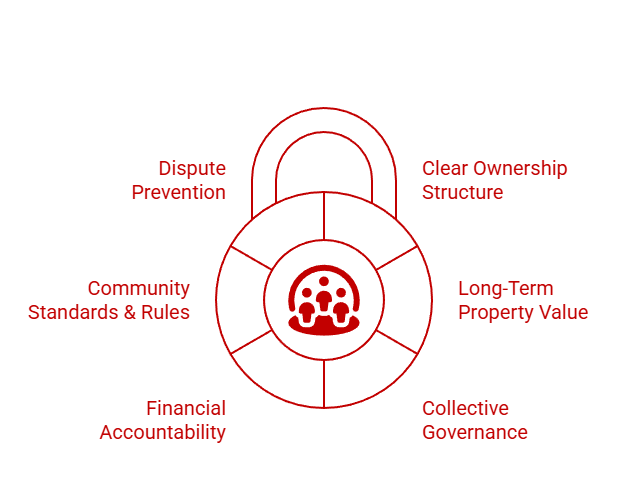
Strata title plays a crucial role in how properties are owned, managed, and valued in Malaysia, especially as more developments move towards high-rise and community-living models.
Understanding how strata ownership works helps buyers protect their investment, navigate shared responsibilities, and ensure their development is well-run and sustainable in the long term.
Here’s why strata title truly matters:
- Clear Ownership Structure:
You hold exclusive rights to your unit and shared rights to common property, giving clarity over what you own and what the community collectively manages. - Long-Term Property Value:
Well-maintained common areas, transparent finances, and strong management can significantly enhance your property’s resale and rental value. - Collective Governance:
Through the Management Corporation (MC), owners participate in decision-making, from budgeting to by-law updates, ensuring the development is governed responsibly. - Financial Accountability:
Regular maintenance fees and sinking fund contributions support repairs, upgrades, and essential services, preventing deterioration and costly future issues. - Community Standards & Rules:
Bylaws help maintain order, safety, and harmony, creating a well-regulated living environment for all residents. - Dispute Prevention:
Clear legal structures reduce conflicts over facilities, boundaries, and responsibilities by outlining rights and obligations from the start.
These factors make strata title a vital framework that not only protects individual ownership but also supports the long-term value, harmony, and sustainability of the entire development.
Strata Title vs Individual Title – Which One Suits Your Property Goals?
Choosing between a strata title and an individual title is one of the most critical decisions buyers make when selecting a property in Malaysia. Each title offers a different ownership experience, level of control, and potential for long-term value.
Understanding these differences helps you decide which option aligns better with your lifestyle, investment goals, and expectations for maintenance and governance.
Type of Property
High-rise units, gated communities, and townhouses with shared facilities
Landed homes such as terrace houses, semi-Ds, and Bungalows
Ownership Structure
Own your unit + shared ownership of common property
Full ownership of both the land and the building
Management
Managed by a Management Corporation (MC) with collective decision-making
Managed solely by the homeowner, with no shared governance
Maintenance Fees
Mandatory monthly charges and sinking fund contributions
No fixed monthly fees; owner handles maintenance independently
By-Laws & Rules
Must follow community by-laws and shared living rules
Greater freedom; rules depend mainly on local council regulations
Facilities & Common Areas
Includes shared facilities such as pools, gyms, guardhouses, lifts, parks
Limited or no shared facilities unless within a gated community
Value Considerations
Value depends on management quality, facilities, and upkeep
Value driven by land appreciation and individual property condition
Ideal For
Those seeking convenience, facilities, and community living
Those wanting privacy, full control, and long-term land appreciation
The right choice depends on whether you prioritise community living with shared amenities or prefer the independence and long-term land value that comes with individual ownership.
Governing Laws: Foundations of Strata in Malaysia
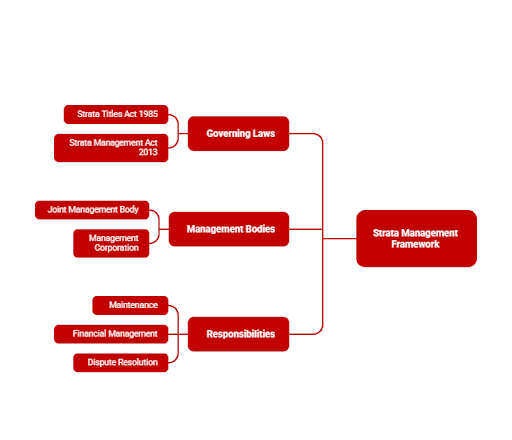
Malaysia’s strata framework is guided primarily by the Strata Titles Act 1985 and the Strata Management Act 2013, both of which lay the foundation for the management, maintenance, and regulation of stratified developments.
These laws form the backbone of strata title requirements in Malaysia, ensuring that each parcel owner has clear rights, access to proper governance structures, and protection of common property.
- The Legal Framework: STA 1985, SMA 2013, and Their Significance
In Malaysia, the primary legislation governing stratified properties is the Strata Titles Act 1985 (STA 1985) and the Strata Management Act 2013 (SMA 2013).
STA 1985 deals with the subdivision of buildings or land into parcels, the issuance of strata titles, and other administrative aspects of parcel ownership.
With the advent of high-rise developments and the proliferation of stratified homes, the SMA 2013 was introduced to provide a comprehensive, uniform framework for the management and governance of stratified developments, maintenance, common property, by-laws, developer responsibilities, joint management bodies (JMB), and later management corporations (MC).
In particular, the SMA aims to protect parcel owners by ensuring proper maintenance and management of common property, fair governance, transparent financial management (including management fees and sinking funds), and dispute-resolution mechanisms.
- How Management of Stratified Properties Works
Under SMA 2013:
- During the initial phase (after vacant possession), the developer remains responsible for maintenance and management until a JMB is formed.
- Once enough units are sold, a Joint Management Body (JMB) is established. The JMB, often comprising both the developer and unit owners, oversees common property management, collects maintenance fees, handles insurance, repairs, and routine upkeep.
- After strata titles are issued and the first Annual General Meeting (AGM) is held, the JMB gives way to a Management Corporation (MC), composed of parcel owners (excluding the developer) for long-term governance.
The MC becomes the legal proprietor of all common property and is responsible for maintenance, financial management, bylaws enforcement, and dispute resolution among owners.
Proper functioning of JMB/MC is essential to ensure that shared facilities remain in good condition, common property is preserved, and owner rights are protected.
Strata Title Challenges: Why Many Owners Still Face Issues in 2026
Despite a robust legal framework, many strata developments in Malaysia face persistent problems.
- Delays in Strata Title Issuance
One of the most critical issues is the delayed issuance of strata titles. In many older or large developments, buyers wait years to receive official title, which affects their ability to refinance, sell, or even properly register legal ownership.
Research on high-rise housing developments found that if a strata title is not delivered within 36 months (as sometimes stipulated in housing development agreements), it creates significant uncertainty for unit owners.
Moreover, for older “special building” schemes (pre-1996 or pre-2007), many owners never received strata titles due to procedural and documentation constraints, leaving a generation of buyers in limbo.
- Governance and Management Issues
Even when a strata title is issued, issues remain. Standard property maintenance may be deferred, repairs neglected, finances mismanaged, and essential facilities deteriorated.
In some cases, JMBs or MCs fail to hold Annual General Meetings (AGMs) as required, undermining transparency and owner representation. A recent study of Johor found that many strata schemes were failing to comply with AGM requirements.
Poor communications between owners, strata managers, and contractors also hamper effective defect rectification and maintenance.
These gaps mean that even though you own a unit, shared areas may suffer neglect; communal debts or mismanagement can impact all owners.
- Legal and Structural Limitations for Older Developments and “Special Buildings”
Some older developments classified as “special buildings” under the STA face greater difficulty obtaining strata titles due to missing technical plans, incomplete documentation, or state-level inconsistencies in the implementation of strata application procedures.
This creates an unequal situation: newer developments generally receive titles and proper management, while older ones remain in a legal grey area, putting owners and buyers at a disadvantage.
What Strata Title Reforms and Expectations in 2026 Could Mean
Given the structural challenges, stakeholders expect reforms and improvements in strata governance and title issuance by 2026. Several proposals and legal reviews are under discussion to tighten compliance, speed up processing, and increase transparency, though specific legislation awaits finalisation.
Some of the reforms being considered include:
- expedited issuance of strata titles upon completion, reducing waiting periods and backlog.
- stronger enforcement of maintenance obligations, bylaws compliance, and financial transparency for JMBs and MCs.
- better mechanisms for dispute resolution, including improved tribunals and mediation frameworks.
- digitalisation of strata management: online strata registers, e-payment for maintenance fees, transparent access to accounts and meeting minutes.
If implemented correctly, these changes would significantly improve buyer confidence, ease resale or refinancing, and ensure long-term sustainability of stratified developments.
What Buyers Should Expect in 2026: Practical Implications
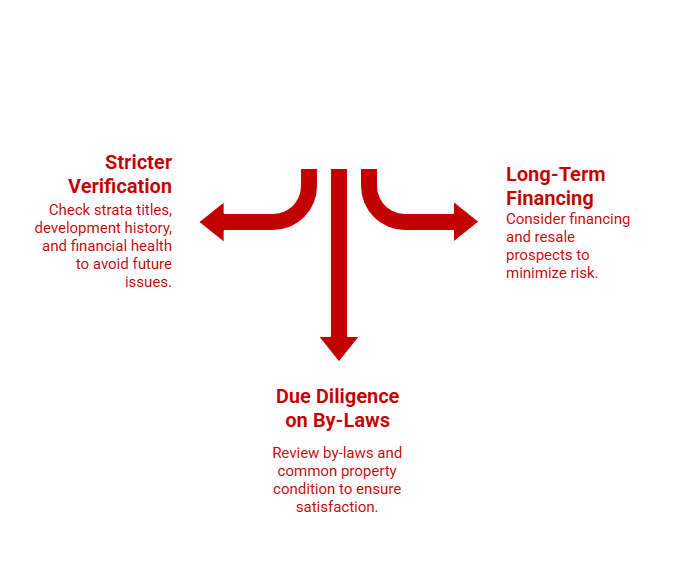
Given the likely reforms and ongoing challenges, here’s what buyers and investors should keep in mind when considering a strata property in 2026.
- Stricter Verification Before Purchase
Before signing agreements, it would be prudent to check:
- Whether strata titles have already been issued or, if new development, what the expected timeline for issuance is.
- The history of the development: when it was completed, who the developer is, and whether there have been past delays or disputes.
- Financial health of the Management Corporation: adequacy of sinking fund, maintenance fee history, pending litigations, or common property issues.
- Due Diligence on By-Laws, Restrictions, and Common Property Condition
Review the by-laws carefully: what are the rules on renovations, short-term rentals, common property usage, parking, and noise? Ensure the standard facilities, lifts, parking bays, and corridors are well maintained.
Check maintenance records, sinking fund levels, and whether regular AGMs have been held. A history of poor upkeep or mismanagement could signal problems ahead.
- Consider Long-Term Financing and Resale Prospects
Units in developments with properly issued strata titles, a strong governance history, and transparent management are likely to have lower financing or resale risk. Banks and valuers prefer such units.
In contrast, units in older “special building” schemes or developments with delayed titles may pose a higher risk for refinancing, resale, or even ownership disputes.
Key Areas for Owners to Watch in 2026 and Beyond
As Malaysia strengthens oversight and digital systems in 2026, strata owners should watch how their Management Corporation handles maintenance, finances, and regulatory compliance.
Well-managed developments tend to enjoy higher long-term value, smoother operations, and fewer disputes. Staying active in meetings, tracking the sinking fund, and keeping up with new by-laws helps protect both your investment and your living environment.
- Maintenance and Common-Property Management
Owners should expect improved oversight and accountability from their JMBs or MCs. With potential new regulations, annual audits of maintenance funds and sinking funds may be enforced more strictly. The focus will likely be on upkeep of shared amenities, structural maintenance, insurance, and compliance with safety standards.
- Governance, Transparency, and Participation
Effective strata living depends on owner participation. Attend AGMs, vote in Management Committees, and demand transparency in accounts and in the upkeep of common property. As regulatory scrutiny increases, MCs will need to be more transparent and accountable.
- Dispute Resolution and By-Laws Enforcement
With likely enhancements to dispute-resolution mechanisms (possibly strengthened tribunals, clearer by-laws, and better-defined owner/developer responsibilities), owners should keep records of renovations, use of common areas, and any communications with MCs/JMBs.
- Impacts on Investors and Foreign Buyers
For investors, especially those purchasing for rental or resale, 2026 reforms may bring greater clarity and reduce risk. Proper strata governance enhances property value, enables smoother financing, and reduces the chances of legal disputes.
Foreign buyers (if permitted) should pay special attention to strata documentation, by-laws, and maintenance history before committing, as post-purchase governance and compliance matter just as much as the unit itself.
Browse Our Exclusive Property Listings
See the best homes for sale right now.
Preparing Yourself for Malaysia’s 2026 Strata Landscape
Understanding the evolving strata title landscape in Malaysia is essential, as 2026 brings greater emphasis on compliance, transparency, and digital governance across stratified developments. Whether you are a buyer, owner, or investor, keeping up with regulatory changes, verifying strata title status, and assessing the Management Corporation’s financial health will help protect your long-term interests.
With better enforcement, improved issuance timelines, and clearer management frameworks, 2026 is set to strengthen confidence in Malaysia’s stratified property market, making informed decision-making more crucial than ever.
For more insights into Malaysia’s evolving strata landscape and property trends, explore the latest PropertyGuru guides for buyers and investors.
Ready to discover opportunities? Check out Malaysia’s curated luxury property listings and find a premium home that fits your lifestyle and goals for 2026.
Disclaimer: The information is provided for general information only. PropertyGuru International (Malaysia) Sdn Bhd makes no representations or warranties in relation to the information, including but not limited to any representation or warranty as to the fitness for any particular purpose of the information to the fullest extent permitted by law. While every effort has been made to ensure that the information provided in this article is accurate, reliable, and complete as of the time of writing, the information provided in this article should not be relied upon to make any financial, investment, real estate or legal decisions. Additionally, the information should not substitute advice from a trained professional who can take into account your personal facts and circumstances, and we accept no liability if you use the information to form decisions.