


Malaysia’s property market in 2026 is experiencing a significant shift as new rail lines and transit upgrades reshape buyer demand. As cities become denser and populations grow, accessibility increasingly influences purchasing decisions. This has amplified interest in Malaysia’s transit-oriented development, where well-connected, walkable neighbourhoods are becoming top choices for both homebuyers and investors seeking long-term value.
Major rail projects such as the MRT3 (Circle Line), LRT3 (Shah Alam Line), the Johor Bahru-Singapore RTS Link, and the proposed Penang LRT are significantly improving connectivity across key regions.
These upgrades are making travel faster and more convenient for daily commuters. As a result, they are strengthening the adoption of transit-oriented development as a guiding principle for modern urban planning in Malaysia.
As transit connectivity improves, properties located near rail stations or transport corridors are gaining significant attention. This shift is decisive among young professionals, families, and investors seeking long-term growth.
This article explores how these transit projects are influencing property values, how buyer behaviour is changing in 2026, and the risks and considerations that come with purchasing near transit-oriented zones.
Discover Your Perfect Home Today
Browse the latest sales listings and find your dream property.
Understanding What Defines A True Transit-Oriented Property
A property is considered truly transit-oriented when it supports walkability, accessibility, and daily convenience. It must offer more than just proximity to a train station. While proximity to an MRT, LRT, or RTS station is necessary, a genuine transit-oriented location also features strong transport connectivity, nearby amenities, and thoughtful urban design.
- Walking Distance to a Rail Station (Usually 400-800 metres)
TOD properties are typically located within a comfortable walking distance of public transport. This range, often referred to as the “first mile/last mile,” allows residents to reach stations without a car or shuttle bus. Pedestrian-friendly walkways, clear signage, and shaded pathways enhance this accessibility.
- Seamless Access to Daily Amenities
Transit-oriented communities place essential amenities within easy reach, including supermarkets, eateries, clinics, banks, and childcare centres. The aim is to allow residents to accomplish everyday tasks within a short walk, reducing dependency on driving.
- Mixed-Use Planning and Integrated Developments
Many TOD areas feature mixed-use developments that combine residential units with retail outlets, office spaces, and lifestyle facilities. This creates vibrant, self-sustaining neighbourhoods where residents can live, work, and socialise with greater convenience.
- Safe and Walkable Urban Design
Wide walkways, pedestrian crossings, proper lighting, and cycling lanes contribute to a safe and comfortable walking environment. A well-designed TOD area prioritises pedestrians over vehicles, creating a more pleasant and community-focused space.
- Strong Feeder Connectivity
Even when walking distance is slightly longer, reliable feeder bus services, shuttle systems, and nearby expressway links can support a TOD ecosystem. These services ensure smooth movement between the property, the transit station, and surrounding work or leisure hubs.
- Reduced Dependency on Cars
A true transit-oriented community encourages residents to rely less on private vehicles. This means lower parking demand, reduced traffic congestion, and a more sustainable living environment, a growing appeal for urban Malaysians.
- Presence of Lifestyle and Community Spaces
TOD areas often include public parks, plazas, community hubs, and social spaces. These elements support community engagement, create identity, and enhance liveability around transit zones.
An actual transit-oriented property offers far more than convenient access to a train station. It brings together walkability, mixed-use planning, reliable connectivity, and a community-centred environment. These elements create neighbourhoods that are not only well-connected, but also more liveable, sustainable, and appealing for long-term residents.
Dreaming of a TOD Property in 2026?
See how much you can afford with the home loan calculator.
Transit-Oriented Development Malaysia: Why 2026 Is a Pivotal Year
Transit-oriented development refers to residential and commercial areas built within walking distance of major public transport stations. These areas offer walkability, mixed-use features, and more effortless mobility. In Malaysia’s evolving urban landscape, TOD is becoming more relevant than ever.
- What TOD Means in the Malaysian Market
TOD in Malaysia typically involves residential, commercial and lifestyle developments clustered within walking distance of rail or transit stations. These projects emphasise:
- Pedestrian-friendly streets.
- Mixed-use developments integrating homes, offices, and retail.
- Higher-density developments near stations.
- Convenient access to public transport.
In Malaysia, TOD is becoming a central part of urban planning, especially in the Klang Valley and other growth corridors, where new rail lines and stations are reshaping growth trends.
- Why Transit Proximity Matters More in 2026
More Malaysians are prioritising transit accessibility for several reasons:
- Higher commuting costs are encouraging households to reduce car usage.
- Younger professionals prefer homes closer to employment centres with reliable transport.
- Workplace trends show continued demand for flexible or hybrid arrangements, but access to transport remains essential.
- Mixed-use developments allow residents to live, work, and shop within the same vicinity.
As a result, TOD Malaysia has become a key factor influencing buyer decisions in 2026.
Major Transit Projects in 2026 Reshaping Property Demand
Several rail projects reaching major milestones in 2026 are strengthening market confidence. Improved connectivity is expected to influence property values in surrounding districts as accessibility improves and travel times shorten.
- MRT3 (Circle Line): The Key Driver of Urban Redevelopment
MRT3 (Circle Line) is a 51 km orbital rail line encircling Kuala Lumpur, linking with multiple existing rail systems to improve city-wide connectivity.
Once completed, it will serve as the loop line of the Klang Valley Integrated Transit System, providing alternative, shorter routes and better access for previously underserved areas.
In 2026, renewed momentum around MRT3 has drawn buyer interest to neighbourhoods expected to benefit, especially those near interchange or connecting stations.
- LRT3 (Shah Alam Line): Strengthening Connectivity Across Klang Valley and Selangor
LRT3 (Shah Alam Line) is another major rail project that will affect buyer behaviour in 2026. Designed to reduce congestion along the Damansara–Puchong Expressway (LDP), New Klang Valley Expressway (NKVE), and Federal Highway, the line will connect Bandar Utama to Klang via Shah Alam.
Stations across mature and developing neighbourhoods will offer commuters an alternative to driving, especially for those working in central business districts or near established urban hubs. As accessibility improves, properties near LRT3 stations have already recorded increased buyer interest, particularly from middle-income households seeking better long-term mobility.
- Johor Bahru–Singapore RTS Link: Cross-Border Demand and Rental Potential
The Johor Bahru–Singapore RTS Link is a transformative project expected to reshape southern Malaysia’s property landscape. Connecting Bukit Chagar in Johor Bahru to Woodlands North in Singapore, the RTS Link is expected to reduce cross-border travel time significantly once operational.
Its impact includes:
- Greater rental demand from cross-border workers.
- Higher interest in centrally located properties within Johor Bahru.
- Potential appreciation as connectivity to Singapore improves.
- Enhanced economic activity in the surrounding areas.
With daily ridership expected to be substantial upon opening, many analysts anticipate the RTS corridor will become a focal point for investors seeking long-term growth.
- Penang LRT: Supporting Growth Along the Bayan Lepas Corridor
The Penang LRT is still in the planning or development phase, but proposals aim to improve mobility within key urban zones along the Bayan Lepas corridor. While implementation timelines remain uncertain, investor interest is growing in anticipation of enhanced transport infrastructure, making areas near proposed routes appealing as long-term plays.
Given historical trends in transit-linked demand across other corridors, such proposals are already influencing market sentiment.
- Supporting Transit Enhancements Strengthening TOD Zones
Beyond the major rail lines, Malaysia continues to upgrade its broader transport ecosystem. This includes improvements to commuter rail services, light rail networks, and key expressway links.
These enhancements strengthen last-mile access to major stations, making it easier for residents to move between neighbourhoods and transit hubs. Together, they support the broader concept of transit-oriented development Malaysia and extend its benefits across both urban and suburban areas.
Most Affordable Transit-Connected Locations for 2026 Buyers
Transit-linked areas continue to offer some of the best value for money in 2026. These locations provide a balance of affordability, growing connectivity, and strong demand from families and first-time buyers.
Klang
LRT3 (Shah Alam Line)
RM280,000 – RM450,000 (High-rise)
RM450,000 – RM700,000 (Landed)
RM450,000 – RM700,000 (Landed)
Lower entry price compared with Kuala Lumpur; strong upcoming LRT3 connectivity; appeal to families and first-time buyers.
Shah Alam
LRT3
RM350,000 – RM600,000 (High-rise)
RM600,000 – RM900,000 (Landed)
RM600,000 – RM900,000 (Landed)
Mature township with established amenities, schools, and expressway links (NKVE, KESAS, Federal Highway). Strong demand from young families.
Seri Kembangan
MRT2 (Putrajaya Line)
RM300,000 – RM550,000 (High-rise)
RM650,000 – RM950,000 (Landed)
RM650,000 – RM950,000 (Landed)
Growing popularity due to MRT2 access, proximity to Cyberjaya/Putrajaya, and competitive psf compared with KL fringe areas.
Tebrau, Johor Bahru
RTS Link Spillover
RM250,000 – RM450,000 (High-rise)
RM500,000 – RM800,000 (Landed)
RM500,000 – RM800,000 (Landed)
Affordable entry point with rising interest from Singapore commuters. RTS Link is expected to improve travel convenience and rental demand.
Penang Mainland (Butterworth, Bukit Mertajam)
Future LRT Feeder Connectivity
RM250,000 – RM450,000 (High-rise)
RM450,000 – RM750,000 (Landed)
RM450,000 – RM750,000 (Landed)
Significantly cheaper than Penang Island; potential uplift once proposed LRT becomes more concrete; good access to ferry and KTM.
Overall, these transit-connected locations offer buyers a practical mix of affordability and accessibility. With improving rail links and steady demand, they remain strong options for those seeking long-term value in 2026.
How Transit-Oriented Development Malaysia Influences Property Values
Transit accessibility is one of the strongest drivers of growth for both residential and commercial properties. As Malaysia expands its transport networks, several market effects are becoming more evident in 2026.
- The Proximity Premium: How Distance to Transit Affects Price Trends
Proximity to rail stations often results in a “proximity premium”; properties within walking distance of stations tend to command higher prices due to improved accessibility. A 2024 analysis by a local portal found that active projects located within 1.5 km of an MRT station consistently posted higher psf prices than those farther away.
Academic and empirical studies support this as well. For instance, a 2025 paper analysing the Sg. Buloh–Kajang (SBK) line showed that residential properties near MRT stations earned significant price premiums relative to those further away.
According to the case study “Estimating the Impact of Mass Rapid Transit (MRT) on Residential Property Values in Greater Kuala Lumpur, Malaysia”, found that typical condominium units within 0.4 km of an MRT station could expect a premium of around 9.5% after the system became operational.
These findings illustrate that transit proximity remains a tangible value driver, reinforcing the appeal of TOD Malaysia developments.
- Rental Performance Near Transit Stations
Properties near transit hubs also tend to perform better in rental markets. Ease of commuting, connectivity to employment centres and amenities, and access to public transport make these properties attractive to tenants, especially working professionals, expatriates, and small families.
Market commentary from 2025 suggests that transit-proximate properties often command higher rental yields than citywide averages, owing to consistent tenant demand.
As more rail lines come online in 2025–2026, these rental advantages are expected to become more pronounced, making TOD Malaysia a compelling choice for investors seeking a stable yield.
- Lifestyle and Commercial Growth Around Transit Hubs
Transit hubs often attract retail outlets, offices, and service-based businesses, creating well-rounded communities. Mixed-use developments combining residential, retail and office space around transit nodes deliver fully fledged communities, improving convenience and liveability.
As more transit projects progress, areas near stations are attracting integrated developments, reinforcing property values in those zones and enhancing long-term demand from both residents and renters.
Which Areas Are Seeing Property Value Shifts in 2026?
While TOD Malaysia benefits many urban centres, a few areas are seeing more evident signs of growing demand based on transit improvements and evolving urban planning.
- High-Demand Transit Corridors in the Klang Valley
Neighbourhoods aligned with major upcoming projects like MRT3 and LRT3 have become focal points for new buyer interest.
Locations within the Klang Valley and surrounding suburbs, especially those aligned with expressway networks such as the Damansara–Puchong Expressway (LDP), the Sungai Besi–Ulu Klang Elevated Expressway (SUKE), or the New Klang Valley Expressway (NKVE), are gaining traction due to their accessibility and future growth potential.
These zones often offer a combination of accessibility, future potential, and relatively lower entry price compared with established central city areas, making them attractive to first-time buyers and long-term investors.
- Johor Bahru’s Growth with the RTS Link
With the completion of the RTS Link, scheduled for end-2026, Johor Bahru stands to benefit significantly from increased public transport connectivity, especially for cross-border commuters to Singapore. Properties near Bukit Chagar or within easy reach of the new link are increasingly attracting buyers and investors, particularly those seeking rental demand from cross-border commuters.
Given the expected passenger capacity and seamless immigration process at CIQ-enabled stations, this corridor could see a notable uplift in demand, both for rental and purchase, once the RTS Link begins operations.
- Penang’s Strengthening Transit Belt Along Proposed Routes
Though the Penang LRT is still a future project, investor sentiment around future transport-driven growth is already rising, especially in zones along proposed alignments. Long-term buyers who anticipate future connectivity improvements are beginning to consider properties in these areas as strategic plays.
While earlier studies on transit impact have focused primarily on Kuala Lumpur and the Klang Valley, the growing acceptance of TOD in Malaysia suggests that regions such as Penang may see greater interest as plans solidify.
Buyer Trends Emerging Around Transit Nodes in 2026
As transit upgrades progress and TOD Malaysia becomes more prominent, so too are buyer preferences shifting. Notable trends in 2026 include:
- Greater Interest in Integrated Developments
More buyers prefer developments that combine residential units, retail, offices and lifestyle elements in a single hub, reflecting a desire for convenience and reduced commute times. These integrated TOD projects deliver amenities, connectivity, and community in one package.
- Preference for Walkable, Car-Lite Neighbourhoods
With rising traffic and urban congestion, many households now value walkability and nearby amenities over large unit layouts or distant suburban homes. Neighbourhoods near stations, with good pedestrian infrastructure and connectivity, are increasingly preferred over areas that rely heavily on private vehicles.
- Demand for Ready-To-Move-In Properties Near Transit
Rather than wait for future projects to complete, a growing segment of buyers in 2026 prefers properties that are already completed or near completion, where transit access (or imminent connectivity) is clearer. This reduces uncertainty and allows for immediate occupancy or rental yield, a notable shift in buyer behaviour.
These trends show that buyers in 2026 are increasingly valuing convenience, connectivity, and immediate usability, reinforcing the rising importance of transit-oriented development in Malaysia in shaping modern property choices.
New Homes, Just Launched
Check out the latest property offerings and get ahead.
Risks To Be Aware of When Buying Near Transit-Linked Areas
Transit-oriented development Malaysia presents many benefits, but buyers should also consider potential risks:
- Transit project delays or changes – Not all routes or station timelines are finalised; some projects may be deferred or altered, affecting expected connectivity.
- Launch price premiums – New developments near planned or announced stations often include price premiums that may compress potential upside.
- Density, congestion and noise issues – Living near stations can increase exposure to noise, crowds, and traffic.
- Oversupply risks – Some areas may see rapid development, leading to market supply exceeding demand and affecting pricing or rental yields.
- Uncertain Long-Term Maintenance of Infrastructure – Some transit stations or surrounding public amenities may face inconsistent upkeep. Poor maintenance can affect safety, walkability, and the neighbourhood’s overall appeal in the long run.
- Potential for Increased Service Charges in Integrated TOD Projects – Integrated or mixed-use developments near stations often come with higher facility maintenance costs. Over time, service charges may rise due to heavier foot traffic, more facilities, or complex building management needs.
- Higher Competition for Tenants – While rental demand is strong near transit nodes, competition may also rise as more units enter the market. Investors may face periods of vacancy or pressure to reduce rental rates during market slowdowns.
- Parking Limitations and Car-Lite Policies – Many TOD projects intentionally reduce parking lots to support public transport usage. This might be inconvenient for households with multiple cars or frequent visitors.
- Changes in Transit Fare Structure or Policies – Fare increases or changes in service frequency can influence daily commuting costs and desirability. If fares rise significantly, some buyers may find the location less attractive over time.
- Long-Term Construction Impact – Areas undergoing transit construction may experience noise, dust, road closures, and limited accessibility for several years. This may affect rental demand or resale interest until the line is fully operational.
- Gentrification Risks – Transit-linked upgrades may increase property prices faster than local income growth. This could limit affordability for existing communities, leading to social displacement or changing neighbourhood character.
Understanding these factors is essential for balanced, long-term investment planning.
How To Choose the Right Transit-Oriented Property in 2026
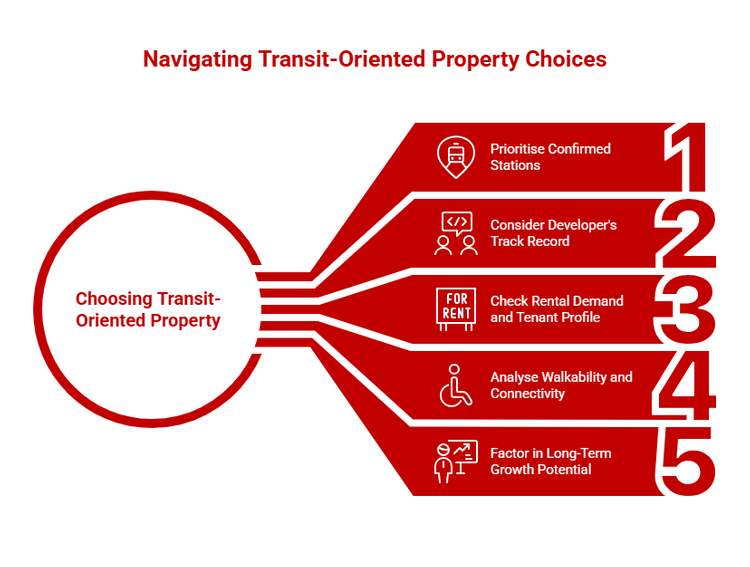
For buyers and investors looking at TOD-linked homes, here are practical guidelines for selecting the right property:
- Prioritise confirmed stations over proposed or speculative routes – Especially for transit projects still in planning, clarity on execution and timeline matters.
- Consider the developer’s track record with integrated or transit-linked developments – Experienced developers may deliver better design, infrastructure and community planning.
- Check rental demand and tenant profile – Areas with strong job centres, education institutions, and amenities tend to support stable rental demand.
- Analyse walkability and last-mile connectivity – including feeder bus routes, expressway access, and pedestrian infrastructure.
- Factor in long-term growth potential and diversification – rather than short-term gains – especially important when buying during early project phases.
By applying these considerations, buyers can make more informed decisions and identify transit-oriented properties that offer both lasting value and strong liveability in 2026 and beyond.
Why Transit-Oriented Development Malaysia Will Continue to Shape the Property Market
Malaysia’s major transport investments are setting the foundation for more connected, efficient, and strategic urban growth. As rail lines such as MRT3, LRT3, the RTS Link, and future LRT proposals shape their respective regions, transit-oriented development in Malaysia will continue to influence property values, rental performance, and buyer preferences in the years to come.
For homebuyers and investors, 2026 offers opportunities to explore emerging transit corridors, especially where confirmed stations, walkable communities, and integrated developments converge. But success requires careful planning, balanced risk assessment, and a long-term outlook.
With the right choices, transit-linked properties in 2026 have the potential to deliver both connectivity benefits and long-term value resilience.
For deeper guidance on evaluating transit-linked properties and long-term investment strategies, explore the PropertyGuru Guides section.
Interested in upcoming transit-connected developments? Check out the new projects shaping Malaysia’s future property hotspots.
Disclaimer: The information is provided for general information only. PropertyGuru International (Malaysia) Sdn Bhd makes no representations or warranties in relation to the information, including but not limited to any representation or warranty as to the fitness for any particular purpose of the information to the fullest extent permitted by law. While every effort has been made to ensure that the information provided in this article is accurate, reliable, and complete as of the time of writing, the information provided in this article should not be relied upon to make any financial, investment, real estate or legal decisions. Additionally, the information should not substitute advice from a trained professional who can take into account your personal facts and circumstances, and we accept no liability if you use the information to form decisions.