


When it comes to buying a home in Malaysia today, many prospective homeowners are asking the same fundamental question: Should I go for renovation vs new build? The decision is no longer simply about price or aesthetics. In 2026, larger forces are at play: shifting buyer preferences, affordability constraints, evolving government incentives, and a property market still adjusting after oversupply challenges.
In this article, you’ll explore what renovation and rebuild actually mean, the key advantages of modern renovation in 2026, why new builds remain appealing for many buyers, the pros and cons of each option, and a practical decision framework for different buyer profiles.
Discover Malaysia’s Latest Property Launches
Stay updated on upcoming projects, new units, and developments entering the market.
What Do Renovation and Rebuild Mean?
Renovation refers to upgrading or refurbishing an existing property without tearing it down. This can range from minor cosmetic changes, like repainting walls, changing flooring, updating fixtures, to more extensive interior overhauls such as redesigning the kitchen, upgrading bathrooms, adding built-in furniture or improving finishes, while keeping the main structure intact.
Rebuild, on the other hand, means demolishing an older structure and constructing a new building on the same land. In many cases, especially for landed properties (terrace houses, semi-detached houses, bungalows), homeowners may choose to rebuild if the existing structure is obsolete, unsafe, or not suitable for modern living standards.
Understanding the difference is crucial. Renovation and new build carry very different implications for cost, regulatory compliance, timeline, and end value.
Malaysia’s Property Market in 2026: Key Shifts Every Buyer Should Know
The Malaysian property market in 2026 is undergoing notable shifts, influenced by oversupply, changing buyer preferences, and evolving government policies. Understanding these trends is essential for homebuyers looking to make informed decisions between renovation vs new build options.
1. Oversupply, Overhang, and Buyer Sentiment
The Malaysian property market in 2025-2026 remains shaped by a lingering oversupply. According to data from the National Property Information Centre (NAPIC), there were 23,515 unsold completed residential units by Q1 2025, valued at roughly RM15.0 billion.
Some later reports suggest the number of unsold completed homes rose to 26,911 units by mid-2025, value estimated at around RM16.4 billion. Developers have responded by scaling down new launches by 46% in the first half of 2025 compared to the same period in 2024.
Some later reports suggest the number of unsold completed homes rose to 26,911 units by mid-2025, value estimated at around RM16.4 billion. Developers have responded by scaling down new launches by 46% in the first half of 2025 compared to the same period in 2024.
However, this has not eliminated demand. Affordable homes (typically priced under RM300,000) continue to attract significant interest, underscoring that many buyers prioritise value and practicality over luxury.
2. Changing Buyer Priorities
Beyond affordability, buyer preferences are evolving. There is growing demand for sustainable housing, energy-efficient features, and homes that offer liveability rather than just square footage. 2026 policies under the national Budget are starting to reflect this shift. For example, certain incentives encourage conversions of commercial stock into residential use, signalling a growing acceptance of adaptive reuse in Malaysian urban planning.
Meanwhile, potential homebuyers are more cautious. With economic headwinds, rising construction costs, and tight financing conditions, many are reconsidering their options, evaluating costs and long-term value more carefully than before.
In this environment, the debate of renovation vs new build becomes more relevant than ever.
Renovation in 2026: Key Advantages and Potential Challenges for Homebuyers
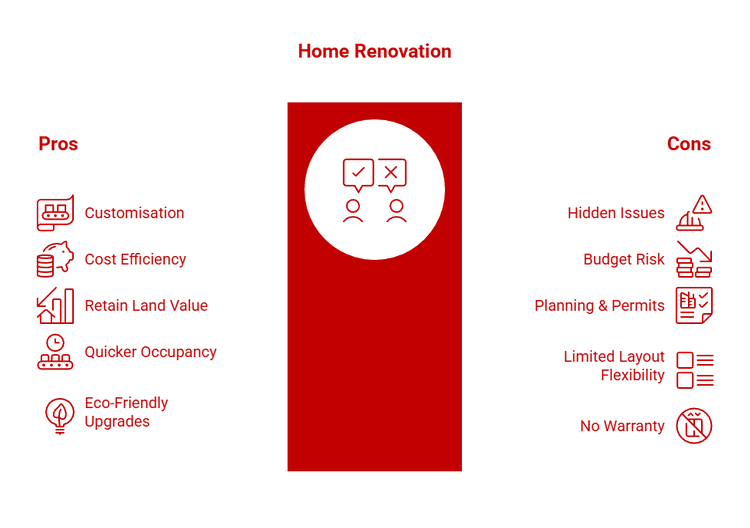
Renovation allows homeowners to transform an existing property to suit their lifestyle and preferences. Evaluating both the benefits and challenges helps buyers decide if renovation is the right choice.
Pros of Renovation
- Customisation: Tailor layouts, finishes, and interiors to your lifestyle, creating a home that perfectly reflects personal taste and practical needs.
- Cost Efficiency: Often more affordable than purchasing a new build, particularly when targeting mid-level upgrades without compromising quality or functionality.
- Retain Land Value: Especially for landed properties in mature neighbourhoods, the land itself continues to appreciate even if the structure is older.
- Quicker Occupancy: Minor renovations can be completed faster than waiting for a new build under construction, allowing immediate use.
- Eco-Friendly Upgrades: Opportunity to integrate energy-efficient fixtures, sustainable materials, and smart-home technology for a greener, future-proof home.
Cons of Renovation
- Hidden Structural Issues: Old wiring, plumbing, or foundation problems may surface, significantly increasing cost and renovation timelines unexpectedly.
- Budget Risk: Renovation expenses may escalate beyond initial estimates due to unforeseen issues or changes in design scope.
- Planning & Permits: Requires careful management of permits, approvals, and professional inspections to ensure compliance with local regulations.
- Limited Layout Flexibility: Existing structure can restrict major redesigns, preventing full realisation of the desired modern layout.
- No Warranty: Unlike new builds, renovated properties usually do not come with developer protection against defects or failures.
Renovation offers a personalised, cost-effective, and flexible path for buyers who value location and control over design. However, it requires careful planning, budgeting, and inspection to avoid hidden costs and structural issues.
New Build in 2026: Key Advantages and Potential Challenges for Homebuyers
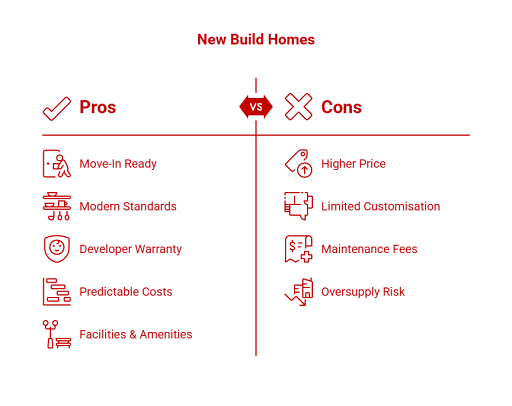
New builds offer buyers a move-in-ready home with modern features and contemporary design. Exploring the advantages and limitations ensures buyers choose a property that suits their needs and lifestyle.
Pros of New Build
- Move-In Ready: Minimal immediate maintenance required, allowing homeowners to settle in quickly without unexpected repairs or delays.
- Modern Standards: Latest construction, wiring, plumbing, and finishes ensure safety, durability, and compliance with 2026 building regulations.
- Developer Warranty: Provides protection against structural defects, construction flaws, and common issues during the defect liability period.
- Predictable Costs: Fewer unexpected expenses arise, giving buyers a clear understanding of total financial commitment from the start.
- Facilities & Amenities: Access to communal spaces such as gyms, swimming pools, and security enhances lifestyle and convenience for residents.
Cons of New Build
- Higher Price: Typically costs more per sq ft than existing homes, often due to developer premiums and modern finishes.
- Limited Customisation: Buyers have restricted freedom to change layouts or finishes, requiring them to accept standard developer specifications.
- Maintenance Fees: High-rise units often carry management fees, sinking funds, and communal area maintenance responsibilities, adding to ongoing costs.
- Oversupply Risk: Certain high-rise or mass-market units may face slower resale or rental uptake due to market overhang and unsold inventory.
New builds offer convenience, predictability, and modern living standards, making them ideal for buyers prioritising move-in readiness. However, they come with higher costs, limited customisation, and potential maintenance obligations.
Property Guides for Confident Home Choices
Get clear, practical advice to help you navigate buying, selling, renting, or investing in Malaysia’s property market.
Renovation vs New Build: Pros and Cons Compared
Deciding between renovation and new build requires careful evaluation of your priorities, budget, and lifestyle. This comparison highlights the key advantages and disadvantages of each option to guide Malaysian homebuyers in 2026.
Renovation
Customisable, cost-efficient, retains land value, faster occupancy, eco-friendly upgrades
Potential hidden issues, renovation costs can escalate, requires planning or inspections
New Build
Move-in ready, modern standards, developer warranty, predictable costs, facilities included
Higher price, limited customisation, maintenance fees, possible oversupply in high-rise segments
Both renovation vs new build have distinct benefits and drawbacks. Understanding these pros and cons helps buyers make an informed decision that aligns with their budget, lifestyle, and long-term goals.
Cost Breakdown: Renovation vs New Build
Understanding the financial implications is crucial when deciding between renovation and a new build. Costs vary widely depending on property type, location, scope of work, and finishes, but breaking them down can help buyers make informed decisions.
1. Renovation Costs
Renovating an existing property often involves:
- Purchase Price of the Existing Home: Typically lower than a comparable new build, especially in established neighbourhoods.
- Renovation Expenses: Includes materials, labour, interior design, and potential structural upgrades. Minor updates cost less, while major redesigns or extensions can significantly increase the budget.
- Contingency: Allocate 10–20% of the renovation budget for unforeseen issues such as hidden plumbing or structural problems.
- Professional Fees and Permits: Architect, engineer, and contractor fees, as well as local permits, must be factored in.
- Long-Term Maintenance: Older properties may require ongoing upkeep even after renovation.
2. New Build Costs
Purchasing a new build typically includes:
- Purchase Price: Often higher than an existing property but reflects modern standards, developer warranties, and facilities.
- Legal and Stamp Duties: Standard transaction costs including Sale and Purchase Agreement (SPA) fees, stamp duty, and legal representation.
- Customisation Costs: Minor upgrades or optional add-ons offered by developers may increase the overall spend.
- Maintenance and Management Fees: High-rise or gated developments usually charge monthly maintenance fees and sinking fund contributions.
While renovation may appear more affordable upfront, buyers must account for potential hidden costs and longer timelines. New builds offer predictable expenses and move-in readiness, but the higher purchase price and recurring fees can impact long-term affordability. Comparing total outlay, including both upfront and ongoing costs, is essential to determine which option delivers the best value for your needs.
Buyer Profiles: Choosing Between Renovation and New Build Based on Your Needs

Not all homebuyers are the same. The right choice often depends on your personal situation, priorities, and long-term plans. Here is a breakdown of typical buyer profiles and which option may suit them best:
1. First-Time Homebuyers, Young Couples, Busy Professionals
These buyers typically prioritise convenience, minimal hassle, predictable costs, and modern design. For them, a new build is often ideal, providing move-in readiness, minimal renovation requirements, and access to contemporary amenities.
2. Families Needing Space or Landed-Home Seekers
Families who value land, outdoor space, proximity to schools, and expansion potential may find renovation, or even rebuilding, of a well-located existing landed property offers greater long-term value and flexibility.
3. Buyers Focused On Personalisation and Lifestyle (Work-From-Home, Custom Layouts, etc.)
Homeowners seeking tailored layouts, built-in furniture, dedicated workspaces, eco-friendly features, or other lifestyle-focused upgrades often prefer renovation. These goals may not be easily achievable in a new build without incurring additional costs.
4. Investors or Long-Term Holders (Resale or Rental Mindset)
For landed properties in mature locations, renovation or rebuilding can deliver higher returns, particularly considering land appreciation. For high-rise or mass-market units, new builds may be more attractive, especially when factoring in developer incentives or lower maintenance fees.
5. Budget-Conscious Buyers or Value-Seekers
Buyers looking for value per Ringgit may find that existing homes requiring renovation offer better affordability, especially in locations near transit or amenities. Renovation also allows gradual upgrades, avoiding the premium cost of a brand-new property.
Understanding your personal priorities, lifestyle, and investment goals is key to choosing between renovation vs new build. Aligning your decision with your profile ensures a home that meets both your immediate needs and long-term plans.
2026 Home Renovation Trends in Malaysia

Renovation in 2026 is no longer just about fixing what is old; it is becoming a way for homeowners to express lifestyle, adapt to modern living, and future‑proof their homes. Several emerging trends are shaping how Malaysians renovate today.
1. Sustainable & Eco‑Friendly Design
More homeowners are opting for low‑VOC paints, bamboo or certified hardwood flooring, energy‑efficient lighting, and other eco‑conscious materials. Using recycled or locally sourced materials is gaining popularity, helping reduce environmental impact while also offering durability suited to Malaysia’s climate.
2. Smart Home Integration
Technology is playing a bigger role in modern homes. Smart lighting, automated climate control or air‑conditioning, voice‑managed security systems, and IoT‑enabled appliances are now being incorporated into renovation plans. This helps make living more convenient, efficient, and ready for future lifestyles.
3. Open and Flexible Layouts
Open‑concept living remains a hit, particularly for apartments and smaller homes. Walls are being removed to merge living, dining, and kitchen areas, improving natural light, ventilation, and a sense of space. For those with limited space, multifunctional rooms and modular furniture provide flexibility, turning a living room into a home office or dining space as needed.
4. Biophilic and Nature‑Inspired Elements
Bringing nature indoors is trending. Many homeowners are adding indoor plants, vertical green walls, natural wood or stone textures, and larger windows or open‑to‑outside access to integrate light and air. The aim is to build a home that feels calm, refreshing, and grounded, an appealing contrast to dense urban living.
5. Warm Earthy Colours and Textured Finishes
Interiors are shifting away from stark white or cold minimalism. Tones like terracotta, olive green, warm beige, wood finishes, and textured walls or surfaces are becoming common. These give homes a cosy, inviting atmosphere, ideal for families or homeowners seeking comfort.
6. Multifunctional Spaces for Modern Lifestyles
With remote work, blended schedules, and evolving family needs, homes today often need to serve multiple purposes. Renovation trends show this through rooms that can double as home offices, guest rooms, study areas, or recreation zones. Built-in storage, convertible furniture, and flexible layouts help maximise utility.
These 2026 renovation trends allow homeowners to create modern, efficient, and personalised spaces at a more practical cost, making it an increasingly appealing alternative to new builds.
Find Your Ideal Home for Sale
Browse a wide selection of houses across Malaysia to buy with confidence.
Avoiding Common Mistakes When Renovating or Buying a New Build in 2026
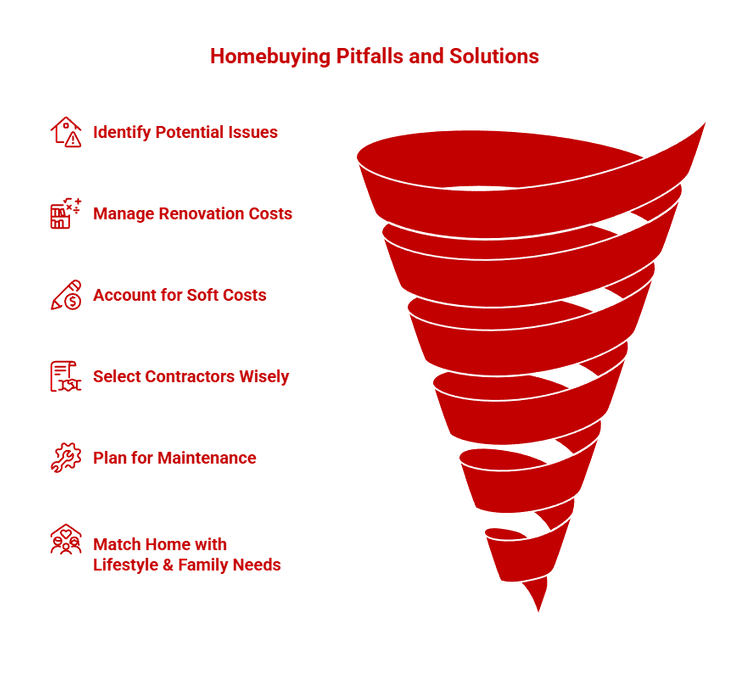
Even with careful planning, pitfalls exist. Many homebuyers avoid them or regret them later. Here are common mistakes and how to sidestep them:
1. Underestimating Hidden Issues in Old Homes
Old wiring, rusted plumbing, termite damage, and structural cracks can significantly inflate renovation costs and timelines. Always insist on a professional inspection covering plumbing, electrical systems, and structural integrity before purchase, and budget at least 10–20% contingency for unforeseen issues.
2. Overspending On Renovation (Over Capitalisation)
Spending too much relative to the value of the neighbourhood or property may result in negative returns. Set a renovation budget as a percentage of the expected market value and avoid exceeding it.
3. Ignoring Soft Costs – Permits, Compliance, Professional Fees
Renovation or rebuild projects often require approvals, compliance checks, and professional fees for architects or engineers. Include these costs early in your budget to prevent surprises.
4. Poor Contractor Selection or Inadequate Planning
Unreliable contractors, unclear project scope, delays, and poor workmanship often result from insufficient planning. Obtain multiple quotes, check references carefully, and sign contracts that clearly define the scope, timeline, and contingency clauses.
5. Neglecting Long-Term Maintenance (For New Builds)
New-build developments, especially high-rise properties, come with maintenance fees, management charges, and communal area upkeep. Evaluate maintenance fees, sinking fund requirements, and the management body’s track record before committing to a purchase.
6. Failing To Match Home Choice With Lifestyle or Family Needs
Choosing a high-rise unit when outdoor space is essential, or a landed property without planning for future maintenance, can create challenges. Clearly list your lifestyle needs, including space, commute, future expansion, and resale potential, before making a decision.
Being aware of common pitfalls and planning proactively can save buyers significant time, money, and stress. Thoughtful preparation ensures your home choice aligns with both lifestyle needs and long-term goals.
Renovation vs New Build: A Practical Framework to Guide Your Decision
Making the right choice between renovation vs new build requires careful thought about budget, lifestyle, and long-term goals. This guide provides a structured approach to help Malaysian buyers make a confident decision in 2026.
1. Assess Your Budget
Start by reviewing your total financial commitment, which includes the purchase price, down payment, legal fees, renovation or rebuild costs, a contingency of 10–20%, and ongoing maintenance fees for high-rise properties. If the combined cost of purchasing and renovating an existing home remains below or comparable to a new build in a similar location, renovation can often provide better value.
2. Define Your Needs and Lifestyle
Consider what matters most in your home. Do you require extra space, land, or flexibility in layout? Are you comfortable with the age and condition of an existing property if renovating, or do you prefer a move-in-ready new build? Understanding your lifestyle priorities will help determine which option is more suitable.
3. Inspect and Evaluate the Property (For Existing Homes)
For renovation projects, a professional inspection is essential. Assess plumbing, electrical systems, and structural integrity to identify potential issues and estimate realistic renovation costs, including contingency to avoid unexpected financial burdens.
4. Check Market Conditions and Resale Potential
Analyse the location and demand for the property type you are considering. For landed properties, evaluate land value and neighbourhood demand. For high-rise or new builds, consider maintenance fees, occupancy rates, and potential oversupply. Align your decision with your long-term objectives, whether for personal use, rental income, or resale.
5. Match With Your Long-Term Plan
Consider how long you intend to hold the property. If you plan to live in it for 10–20 years, personalisation and customisation may carry more weight. If resale or liquidity is more important, assess how market cycles, oversupply, and segment demand could affect future property value.
Careful evaluation of budget, lifestyle, property condition, and market trends ensures a well-informed choice between renovation vs new build. Following this structured approach helps Malaysian buyers make confident, long-term decisions in 2026.
Making the Right Choice
The debate of renovation vs new build in Malaysia in 2026 is not a one-size-fits-all question. It depends on your budget, lifestyle, long-term goals, and risk appetite. Renovation offers customisation, potential cost efficiency, and preservation of valuable land or location, especially for landed homes. Meanwhile, a new build brings convenience, predictability, and a turnkey solution with modern standards.
Given the current market, oversupply in some segments, rising demand for affordability and sustainability, and changing buyer preferences, renovation could be the smart, value-driven choice for many. But for those seeking ease, minimal fuss, and a ready home, a new build remains a valid and often wise option.
Before you decide, take time to inspect the property, build a realistic budget (including contingency), and align the choice with your long-term plan. That way, whether you choose renovation or new build, you end up with a home that meets your needs and peace of mind. Discover prime plots and investment-ready land to suit your development or personal needs. Browse Residential Land for Sale on PropertyGuru Malaysia.
Keep Track of New Launches
Visit our new launches page to find the new launch project of your dreams and submit an enquiry today.

Disclaimer: The information is provided for general information only. PropertyGuru International (Malaysia) Sdn Bhd makes no representations or warranties in relation to the information, including but not limited to any representation or warranty as to the fitness for any particular purpose of the information to the fullest extent permitted by law. While every effort has been made to ensure that the information provided in this article is accurate, reliable, and complete as of the time of writing, the information provided in this article should not be relied upon to make any financial, investment, real estate or legal decisions. Additionally, the information should not substitute advice from a trained professional who can take into account your personal facts and circumstances, and we accept no liability if you use the information to form decisions.