


Still working from home (WFH)? Welcome to the club! According to a 2020 estimation done in early 2020 (when the COVID-19 virus was just beginning its attack), approximately one in six workers at the global level were thought to be WFH.
Though more and more Malaysian companies have begun to welcome employees back to the workplace, many still choose to continue their WFH arrangements for the safety and convenience.
This can be seen in the data from our Consumer Sentiment Study H2 2021; we found that more than two in three Malaysians are currently working from home, particularly younger Malaysians in the mid to high income group.
With the majority of our time now spent in our homes, we can only imagine how expensive the utility bills must be – electricity, water, WiFi, cooking gas etc!
With all those increased costs, it’s also no wonder why Malaysians have found it more important than ever to adopt a sustainable lifestyle, with a whopping 90% of respondents indicating thus!
More than half would prefer a home that’s close to public transportation, so that they are able to travel with ease and cut down on private vehicle usage.

The rest would prefer a home that’s able to help them save money on their electricity bills, such as a smart cooling system, solar panels, as well as highly insulated windows and doors.
You don’t need to blow a fortune to make your home and lifestyle sustainable, though! Let’s take a look at some oft-overlooked simple tips on how you can go green while you WFH.
Start From Your Home Office
1) Ditch the disposable coffee capsules
A great work day starts with a great cup of coffee, and we’re sure many would agree (especially if it’s after an extended weekend!).
Most conventional coffee machines however, use plastic coffee capsules which are difficult to decompose and can pile up over time. Consider switching to reusable coffee capsules or opting for other methods of home brew.
Some other options you can explore include pour over coffee, using a french press, or cold brewing your coffee. A small home espresso machine could be a good option as well, but tends to consume more energy.
2) Consider the positioning of your workstation

With coffee in hand, you can move over to your desk and get the day started! Now, where your work desk is positioned can make a difference in your carbon footprint too.
If your desk is positioned against or nearby a window, you can take full advantage of natural sunlight to light up your workstation, and thus use less electricity.
On the flipside, our hot Malaysian rays can easily overheat your devices – and yourself too! This may make you reach for the air-conditioner controller sooner than necessary.
One option is to place your desk a slight distance away from the window or choose a different orientation if possible, but alter your environment to better reflect light coming in from the window. Here’s how:
- Keep your surroundings a lighter, brighter color (white work desk, pale walls, etc.)
- Have less fabric (for example, the curtains) and less clutter around your workstation
- Use mirrors or glass fixtures in the room to reflect more light
3) Limit your devices
We have to ask: Do you really need four different screens staring back at you?

Having a desktop, laptop, tablet, and phone all plugged in and running at the same time may be more convenient, but isn’t always necessary (depending on your job, of course). Don’t forget your earphones, speakers, and printers too!
Try to limit the number of devices you use to the bare minimum, and unplug them when not in use. If you have the ability to choose, laptops consume significantly less electricity than desktop setups.

It’s lunchtime!
4) Less takeout, more home-cooked meals
You’ve only got an hour or so before it’s back to endless meetings again. As tempting as it is to just get takeout or food delivery, whipping up a quick meal saves you money AND reduces your carbon footprint.
Ordering, processing, packaging and transporting meals means it takes a lot more energy to get those meals to you – especially if it’s on a twice-daily basis. Below are some in-depth tips on how to cook at home more intentionally:
- Making minimal-preparation meals (e.g. salads over stews)
- Using local produce that’s in season
- Plan your meals in advance
- Batch cook your meals (more food made, which is frozen and reheated over the next few days)
5) Deep clean your refrigerator
Your refrigerator is one of the most energy-hungry appliances in your household. It only makes sense that once every few months, deep clean your refrigerator and freezer to get rid of those old condiments, expired salad dressings, and mystery mouldy jars.
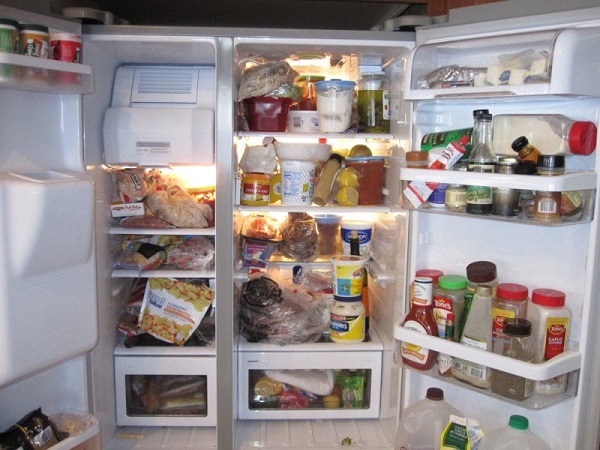
They can limit the air circulation and reduce its cooling efficiency, which means it has to burn more energy to keep the insides at optimum temperature, so make sure to periodically purge your refrigerator of unwanted goods.
Deep cleaning also means thawing out the ice on the bottom and sides of your freezer. Just 2mm of ice is enough to consume an extra 10% of energy!

When It’s Time To Start Winding Down
6) Create your own high-yield garden
Finally! You’re mostly done with work and you can spend some time in the garden to give your eyes some rest from the screens. Perhaps consider starting a small garden of your own?
High-yield native vegetables such as bok choy, bayam, and ladyfingers grow well and provide optimal turnover, compared to crops such as pumpkins and melons.
Local herbs such as curry leaves, coriander, and lemongrass also mean you can readily access them for your cooking.
Growing at least a portion of your own produce means you buy less plastic-covered ones at the grocery store – where processing and logistics also means a bigger carbon footprint.
Having a garden on your own also means you can reuse any organic kitchen scraps for compost, and harvested rainwater for watering crops on dry days.

7) Sleep in the same room you work in
Most experts advise to keep your workspace and sleep area separate to help improve the quality of your sleep, so take this tip with a grain of salt!
From a purely environmental and financial perspective however, it can be more energy-efficient to sleep in your home office, or work in your bedroom.
If you’re someone who keeps your home office (or whichever room you do your work in) air-conditioned, only to then head over to your bedroom and turn on the air-conditioning there – this will help you save on your electricity bill and reduce your greenhouse gas emissions.
Start Small In Your Green WFH Journey
From your garden to your bathroom, there are opportunities to conserve energy and cut down utility costs wherever you look.
But don’t let that overwhelm you! Start making small changes over time, and your efforts will pay off in the long run.
Relevant Guides:
Disclaimer: The information is provided for general information only. PropertyGuru International (Malaysia) Sdn Bhd makes no representations or warranties in relation to the information, including but not limited to any representation or warranty as to the fitness for any particular purpose of the information to the fullest extent permitted by law. While every effort has been made to ensure that the information provided in this article is accurate, reliable, and complete as of the time of writing, the information provided in this article should not be relied upon to make any financial, investment, real estate or legal decisions. Additionally, the information should not substitute advice from a trained professional who can take into account your personal facts and circumstances, and we accept no liability if you use the information to form decisions.