


By Adilena Amran (Malaysia Property Inc)
Malaysia has shown progressive improvement as it survived the Asian Financial Crisis in 1997 to 1998 and continues to pursue its economic development plan to become a developed nation by 2020.
From the year 2000 to 2008, Malaysia has seen positive growth averaging 5.5% per year.
Despite being hit by the Global Financial Crisis in 2009, Malaysia recovered rapidly and continued to post higher growth rates in 2010 averaging at 7.2%.
To elevate the country to a developed nation status by 2020, the Malaysian Government started the Economic Transformation Programme in 2010.
This turned out to be a strong catalyst for driving domestic private sector investments for 12 key economic areas including Greater KL/Klang Valley.
Subsequently, the Malaysian economy grew at 5.1% in 2011 and 5.6% in 2012.
In 2011 to 2012, Iskandar Malaysia’s well-planned developments captured international investors’ interests due to its proximity to Singapore as investors viewed Singapore-Iskandar akin to Hong Kong-Shenzhen.
The opening of the Johor Premium Outlet, Southeast Asia’s first luxury premium brand outlet and Legoland Malaysia, the country’s first international theme park as well as many other international universities and health centres further enhanced Iskandar Malaysia’s status.
Quantitative easing in the US a well as a low-interest rate environment in Malaysia since 2000 and easy access to credit fueled property purchases and double-digit hikes in property prices were seen in all states across Malaysia in 2012 and 2013.
The economy slowed to 4.7% in 2013 with the weakening of electrical and electronic exports to US and Europe but bounced back to a 6% growth in 2014.
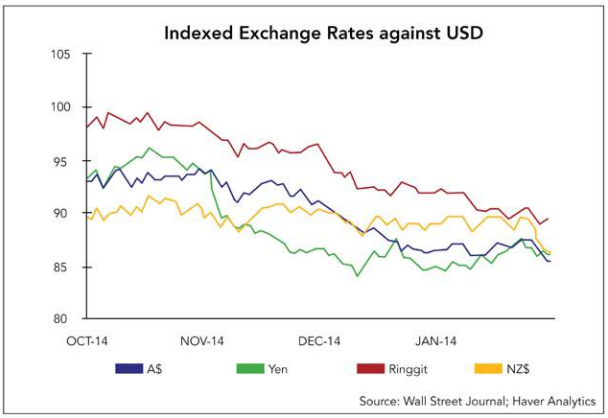
2015 marks another difficult time for Malaysia as it faces a sharp currency exchange fall against the US Dollar and Singapore Dollar.
Ringgit Malaysia (RM) plunged from 3.4300 against the US Dollar in December 2014 to 4.0025 as recorded in August 2015.
A huge gap was created and its volatility appears to be continuing in the coming months. The fallen ringgit was exacerbated with the devaluation of China’s currency, Yuan, in 11 August 2015.
The Ringgit has been sliding downwards for a few months since 11 March 2015 with US Dollar being traded at 3.7105 per Ringgit and continues to decline to 4.0025 recently on 9 August 2015.
Singaporeans have been queuing at the currency exchange counter as Ringgit was traded at 2.77 against the Singapore Dollar.
Property An Inflation Hedge Investment
Property investors or property market players often claim that their investment in real estate acts as a hedge against inflation. What do they mean by this?
Through capital appreciation, property investments do act as a hedge against inflation. The longer the time invested in real estate, the higher the capital appreciation.
Capital appreciation is usually calculated yearly after taking into account tax and insurance payments and under the consideration that the investment is well maintained.
However, during a financial crisis, what will happen?
Currently, the property market has slowed down with buyers and investors, locals and foreigners alike exhibiting more caution against purchasing properties.
Although there are other opinions stating that overseas investment will be profitable in times to come despite the high capital cost that one may incur now.
Local investors are not affected as the decline in the Ringgit does not seem to affect them. Developers have continued to market the price of their properties higher than before.
Foreign transactions are expected to increase as the weaker Ringgit makes Malaysian properties ‘cheaper’.
However, there are certain limitations to foreign transactions as the government has set certain rules and regulations on foreign property ownerships.
As mentioned in the previously published article, 2014 Property Guidelines – Impact on MM2H and Foreigners, the Malaysian government has enforced new foreign ownership rules which permit foreigners to purchase properties above RM1 million for most states in Malaysia and RM2 million for properties in Selangor.
Despite attractive offerings in the Malaysian property market, not all those who comes to Malaysia would consider settling in Malaysia permanently. MM2H holders are the ones who chooses to make Malaysia their second home.
Other than MM2H holders, would it be profitable for the other foreigners to enjoy the market?
Will future liquidation of their Malaysian properties give them as much advantage as when they first bought them? What is actually the indication of such trends?
Property Market
Crude oil prices have plunged by more than 50% over the last 7 months due to the oversupply in the international market amid weak demands.
Crude oil and petroleum-related revenue are undeniably a major source of income for the Malaysian government.
Any changes on the commodity price will therefore have a significant implication on its Gross Domestic Product (GDP).
However, Malaysia does not depend on solely crude oil production.
Malaysia is a country enriched with natural resources. We are the world’s second largest palm oil and natural gas producer, and our local entrepreneurs produce high-quality food and beverages exported globally.
This simply means, although the currency depreciation was worsened by the low crude oil price, Malaysia’s strength has not fallen apart as it also relies on other resources available.
As reported by the media, exporters are likely to benefit from the current depreciation as the foreigners would have more interest in buying Malaysian products which are marketed at a cheaper price compared with previous years.
Knight Frank in their 1H2015: Real Estate Highlights; reported that the Malaysian property market is expected to experience a slowdown in the property transaction.
The volume of high-end condominium transactions has seen a drop in 1Q2015, from 2,088 in 4Q2014 to 1,694 in 1Q2015 which is a 9.1% decline.
There were also expectations that will be more interest in buying the properties before the enforcement of the GST starting on 1 April 2015, however NAPIC data suggests that GST was not the main concern by the investors.
Despite much pressure from the current financial situation and the slowdown effects it has on the property market, developers have yet to show any sign of reducing their prices.
In fact, the firm and strong demand of affordable properties were seen to drive the sales, hence, giving the developers a strong reason to remain modest in their price growth.
Property investments are not as volatile as stocks and shares, thus they perform better and are able to sustain their returns.
To Invest Or Not To Invest
The Ringgit’s gradual depreciation over the past 6 months has definitely affected the locals’ mind set.
“Malaysians are still adjusting to the rising cost of living due to the Goods and Services Tax, so if the ringgit continues to weaken, consumers will definitely be affected,” said an independent economist, Lee Heng Guie.
The property market for now could be the main market people seek as it offers stability and capital appreciation for a long term basis.
The concept “sit and wait” does not work for property investment as waiting before investing would only cause the investor to lose the opportunity to get the property at its cheapest price, as property prices would go up with time and hardly declines.
Moreover, developers were seen investing on the interest of affordable homes targeted at the younger generations, it is highly recommended for the locals to seize the opportunity of such offerings.
Oversea investments may not be practicable for the moment as the Ringgit depreciation may incur higher costs to the investors.
On a positive note, economists suggest that a weaker Ringgit could eventually boost the country’s tourism and stimulate positive growth in sectors such as retail and hotels.
In order to stem the outflow of funds from the country, local pension funds are now investing in local properties to contain the decline of the Ringgit.
With a strong demand for property offerings by locals’ ad foreigners, Malaysian properties remain a stable investments option to investors.
With a better locations and attractive offers, property investment would continue to prove its capability in securing the investors interest.
Keep Track of New Launches
Visit our new launches page to find the new launch project of your dreams and submit an enquiry today.

Disclaimer: The information is provided for general information only. PropertyGuru International (Malaysia) Sdn Bhd makes no representations or warranties in relation to the information, including but not limited to any representation or warranty as to the fitness for any particular purpose of the information to the fullest extent permitted by law. While every effort has been made to ensure that the information provided in this article is accurate, reliable, and complete as of the time of writing, the information provided in this article should not be relied upon to make any financial, investment, real estate or legal decisions. Additionally, the information should not substitute advice from a trained professional who can take into account your personal facts and circumstances, and we accept no liability if you use the information to form decisions.