


When browsing new projects in Kuala Lumpur or any urban centre in Malaysia, you may have come across the term plot ratio in a developer’s brochure or planning document.
For the average homebuyer, it may sound like technical jargon, but this simple ratio actually determines how tall, dense, and profitable a building can be.
In this guide, we’ll break down what plot ratio means, how it shapes Malaysian skylines, why Kuala Lumpur’s plot ratio cap remains a hot topic, and what developers and buyers alike need to know about the latest planning policies.
Find a place that feels right
Compare rental choices within your price range
What Is Plot Ratio?
In simple terms, plot ratio is the comparison between how much you can build and the size of the land you’re building on. It indicates the amount of floor space a developer is permitted to develop on a specific plot of land.
A higher plot ratio means more floor space can be developed, so you’ll often see taller buildings or more residential units on the same piece of land. A lower plot ratio, on the other hand, means less density, fewer floors, and generally more open space or greenery around the property.
Under Malaysia’s Town and Country Planning Act 1976, plot ratio is defined as:
"The ratio of the total floor area of a building to the area of the building plot as measured between the survey boundary lines."
For example, let’s say you own a 10,000 sq ft piece of land with a plot ratio of 1:5. That means you can build up to 50,000 sq ft of total floor area, perhaps as a five-storey building, or spread across several smaller blocks, depending on your design and planning approvals.
Put simply, the plot ratio provides a quick indication of how intensively a piece of land can be developed. It’s a key measure that helps developers plan projects efficiently and helps buyers or investors understand a property’s potential value and scale.
How Plot Ratio Is Calculated?
Plot ratio is expressed as a simple ratio, such as 1:4 or 1:10. The formula is:
Plot Ratio = Total Gross Floor Area ÷ Site Area
For instance, if a developer purchases a 20,000 sq ft plot and the approved plot ratio is 1:8, the total buildable floor area will be:
20,000 × 8 = 160,000 sq ft of floor space
That 160,000 sq ft can be spread across multiple floors, such as an 8-storey commercial block or a 40-storey condominium, depending on the design, height restrictions, and zoning type.
Why Plot Ratio Matters in Development?
Plot ratio isn’t just a technical number; it influences a building’s:
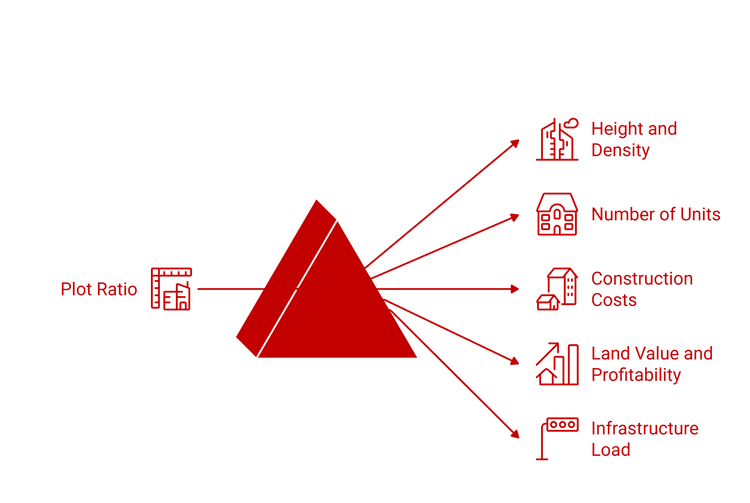
It’s a key factor local councils use to manage urban growth, prevent overcrowding, and maintain a city’s livability.
Plan your financing smarter
Check your repayment range before you proceed.
Who Determines Plot Ratio in Malaysia?
Plot ratios are controlled by local planning authorities, not a single national standard. Each local council, such as Kuala Lumpur City Hall (DBKL), Majlis Bandaraya Petaling Jaya (MBPJ), or Majlis Perbandaran Penang Island (MBPP), sets its own maximum plot ratio limits through its Local Plan (Rancangan Tempatan) or Structure Plan (Rancangan Struktur).
Developers must submit a development plan (DP) or planning submission to the relevant authority before starting construction. This plan details the intended building density, height, and gross floor area.
The authority then evaluates whether the proposed plot ratio:
- Fits the zoning classification (residential, commercial, mixed-use, etc.),
- Aligns with infrastructure capacity, and
- Matches environmental and liveability goals.
If the proposed ratio exceeds the allowed limit, developers may have to amend their plans or pay development charges to compensate for additional strain on infrastructure.
Plot Ratio vs Density: Are They the Same?
Though they’re often used interchangeably, plot ratio and density are not identical.
- Plot ratio measures the total floor area that can be built on a plot.
- Density, on the other hand, refers to the number of dwelling units per acre or hectare.
For example, two projects with the same plot ratio can have very different densities if one has smaller units (more per building) and the other has larger ones.
In short:
- Plot ratio affects built-up area and height.
- Density affects population and occupancy levels.
Both are critical planning tools; together, they shape the way a city grows.
Plot Ratio Caps in Kuala Lumpur (KLCP2020 and 2025 Updates)

Source: BBC
The Kuala Lumpur City Plan (KLCP2020), officially gazetted in 2018, introduced a plot ratio cap of 1:10 for central commercial zones. This was a significant policy shift designed to control urban congestion, especially in the Golden Triangle and Greater KL area.
However, as urban patterns evolved, DBKL’s draft Kuala Lumpur Structure Plan 2040 (KLSP2040) and ongoing expected KLCP2025 reviews (expected to be fully aligned by 2026) have refined how these ratios apply across different neighbourhoods.
Key Highlights, which are kept updated as of 2025:
- The maximum plot ratio of 1:10 remains for central commercial zones.
- Ratios of 1:8 to 1:10 are typically applied to mixed-use developments in urban cores.
- Ratios of 1:4 to 1:6 apply to medium-density residential zones.
- 1:2 to 1:3 caps for low-density suburban areas or eco-sensitive zones.
- Bonus ratios may be allowed for green-certified or transit-oriented projects.
For developers, this means that any project in Kuala Lumpur now faces tighter control over density, particularly if located in established commercial or high-traffic areas.
You can refer to DBKL’s official planning portal for zoning maps and the latest updates to the Kuala Lumpur City Plan.
Impact of Plot Ratio on Property Developers
For developers, the plot ratio directly impacts profitability. A higher cap allows more saleable units on the same land, improving returns.
When authorities impose a stricter limit, developers face:
- Reduced buildable area
- Lower gross development value (GDV)
- Longer feasibility and approval processes
Projects approved under older, more generous ratios may need to resubmit their plans or seek planning variation approvals (PVAs).
As of 2024, developers such as UEM Sunrise, SP Setia, Tradewinds, and IJM Land have raised concerns about how the cap affects project economics, especially in premium locations like Jalan Ampang, Bangsar, and Federal Hill.
Yet, these controls aim to achieve long-term sustainability by curbing overdevelopment and reducing the property overhang, which exceeded RM17 billion in unsold stock nationwide as of 2024.
Why Plot Ratio Matters to Homebuyers and Investors?
While plot ratio may seem like a developer’s concern, it also affects buyers and investors in several subtle but important ways:
- Neighbourhood Density and Privacy
A high plot ratio means more units per plot, potentially resulting in busier surroundings, limited parking, and reduced privacy. - Amenities and Infrastructure Load
Projects with high density often share facilities among more residents, affecting convenience, wait times, and maintenance costs. - Long-Term Property Value
Developments in areas with balanced plot ratios often hold value better due to less saturation. - Urban Liveability
A moderate plot ratio helps maintain ventilation, access to sunlight, and open green spaces, all of which contribute to a better quality of life.
For buyers considering an investment, checking the approved plot ratio through DBKL’s planning system or directly via the developer’s Development Order (DO) is a smart step.
Discover properties for sale in Kuala Lumpur
Find homes that suit your lifestyle.
How Plot Ratio Affects Urban Planning and Liveability?

Plot ratio is more than a technical tool; it’s central to Malaysia’s urban design philosophy.
In cities like Kuala Lumpur, Penang, and Johor Bahru, authorities balance density with infrastructure to prevent issues such as:
- Traffic congestion
- Flooding from excessive hard surfaces
- Insufficient green and public spaces
- Overburdened utilities
Urban planners use plot ratios to maintain a sense of scale and proportion, ensuring the city remains liveable rather than overcrowded.
For example:
- KLCC and Bukit Bintang have higher allowable ratios due to their proximity to public transportation (MRT, LRT, Monorail).
- Residential enclaves like Desa ParkCity or Damansara Heights maintain lower ratios to preserve exclusivity and green space.
Ultimately, plot ratio shapes not just skylines but the everyday rhythm of city life, influencing how comfortably people live, move, and interact within Malaysia’s growing urban landscape.
Plot Ratio Trends and Revisions in 2025
As Malaysia’s urbanisation rate crosses 78% in 2025, plot ratio management has become a significant sustainability concern. Authorities are adopting performance-based planning, rewarding developers who meet environmental or social benchmarks.
Emerging 2025 Trends
- Transit-Oriented Development (TOD) Incentives
Projects within 500 metres of MRT or LRT stations may be allowed slightly higher plot ratios if they include walkable, mixed-use features. - Green Building Bonuses
Developments certified under GreenRE or GBI Platinum are eligible to apply for density or height relaxation. - Digital Transparency
Local councils, such as DBKL and MBPJ, are digitising their planning systems, allowing public access to zoning data and approved ratios. - Suburban Expansion
As plot ratios tighten in city cores, growth is shifting toward Seri Kembangan, Shah Alam, and Rawang, where ratios remain lower, and land costs are more attractive.
In essence, 2025 marks a shift towards more innovative, greener, and more transparent planning, where plot ratio management plays a defining role in shaping Malaysia’s next generation of sustainable cities.
The Verdict for 2026
Plot ratio might seem like an abstract planning term, but it’s the invisible hand shaping every skyline and neighbourhood in Malaysia.
For homebuyers, understanding it helps decode why some condos feel packed while others feel peaceful. For developers, it defines the difference between a feasible project and one that’s financially unworkable. And for city planners, it remains the key to building dense yet liveable cities.
As Malaysia marches toward KLSP2040 and sustainable urbanisation goals, expect plot ratio controls to remain central to shaping greener, more balanced communities.
Explore PropertyGuru’s latest listings to find developments with the proper density, design, and liveability balance for you.
Keep Track of New Launches
Visit our new launches page to find the new launch project of your dreams and submit an enquiry today.

Disclaimer: The information is provided for general information only. PropertyGuru International (Malaysia) Sdn Bhd makes no representations or warranties in relation to the information, including but not limited to any representation or warranty as to the fitness for any particular purpose of the information to the fullest extent permitted by law. While every effort has been made to ensure that the information provided in this article is accurate, reliable, and complete as of the time of writing, the information provided in this article should not be relied upon to make any financial, investment, real estate or legal decisions. Additionally, the information should not substitute advice from a trained professional who can take into account your personal facts and circumstances, and we accept no liability if you use the information to form decisions.