


Becoming a landlord in Malaysia is no longer as simple as collecting rent and maintaining the property. With proposed tenancy reforms, growing tenant awareness, and a more data-driven property market, landlords today must strike a balance between legal compliance and sound management practices.
In 2026, understanding your rights and responsibilities is vital not only for protecting your investment but also for maintaining trust and professionalism in a rapidly changing rental landscape. Whether you own a single condominium unit or manage multiple shoplots, understanding the current rules surrounding tenancy agreements, dispute resolution, and rental law reform will help you stay ahead of the curve.
This guide provides comprehensive information on landlord rights and obligations in Malaysia, including upcoming legal updates, best-practice advice, and practical tips to help you navigate the evolving rental market with confidence in 2026.
| Table of Contents 1. Landlord Rights: An Overview 2. Key Landlord Obligations in Malaysia 3. The Tenancy Agreement: Your Contractual Foundation 4. Do’s and Don’ts for Landlords 5. Avoiding Common Landlord Pitfalls in Malaysia 6. Dispute Resolution: What to Do When Things Go Wrong 7. What’s Changing in 2026: Proposed Laws & Market Trends 8. Practical Tips for Landlords in 2026 9. Next Steps for You |
Explore where you could live next.
Choose from rental units that fit your finances.
Landlord Rights: An Overview
As a landlord in Malaysia, your rights primarily derive from the terms of your tenancy agreement and general contract law. There is no single dedicated federal landlord-tenant statute in Peninsular Malaysia as yet.
For example, according to the Malaysian Bar Council, the landlord’s right to recover possession of the property is contingent upon the tenancy agreement and a court order, rather than self-help eviction.
Nonetheless, you retain core landlord rights such as:
- The right to receive rent on time under the terms of the agreement;
- The right to have your property maintained in good order and returned in good condition (less fair wear and tear);
- The right to seek recourse via the courts if the tenant breaches the contract or fails to pay rent.
- The right to include contractual terms covering subletting, inspection rights, termination notice, utilities and deposit handling.
It is essential to recognise that courts have tended to favour tenants in possession disputes, so the strength of the tenancy agreement is paramount.
Key Landlord Obligations in Malaysia
Being a landlord is more than collecting rent. In Malaysia, while the overarching law remains somewhat fragmented, the following obligations are widely recognised and best practice for residential tenancies:
- Paying the annual quit rent and property assessment (unless otherwise agreed), this remains an owner’s statutory duty.
- Insuring the property, especially if you have let it furnished or partly furnished.
- Providing the agreed-upon appliances or fixtures and ensuring they are in good condition at handover.
- Ensuring the property is habitable and duly maintained – major structural issues, leaks, and defective wiring may expose you to the risk of constructive eviction or a dispute.
- Covering repairs caused by normal wear and tear, unless the tenancy agreement allocates specific responsibilities to the tenant (with clarity).
- Clearly specifying in the tenancy agreement who pays for utilities (electricity, water, internet, etc.), maintenance charges and repair responsibilities. It is best practice to take an inventory and photos of the property condition at handover.
PropertyGuru Tip: Keep a detailed inventory of items you provide to your tenant. Take photographs before the tenant moves in so you can refer to them if there is damage or if the tenant requests repairs.
The Tenancy Agreement: Your Contractual Foundation

Your tenancy agreement is your most important document. With no single federal landlord-tenant statute in force yet (though reform is on the way), the contract governs the relationship and sets your rights and obligations in stone.
What should it cover?
- The names of landlord and tenant, property address and lease term (start and end dates).
- Rent amount, due date, payment mode, and late payment penalties (if any).
- Security Deposit: Amount, Date Paid, Return Conditions, and Refund Timing.
- Utilities: who pays what (electricity, water, internet, maintenance fees).
- Repair/maintenance obligations: specifying landlord vs tenant responsibilities.
- Inventory of furniture/appliances (if furnished) and condition at handover.
- House rules: subletting, pets (if any), smoking, and alterations to the property.
- Inspection rights: notice period for landlord access (except emergencies).
- Termination/renewal: notice period, rent review clause (if applicable), holding-over provisions.
- Dispute resolution clause: a mechanism for resolving disagreements, e-mail or mediation, and references to court if required.
Stamp duty and registration
Although tenancy agreements do not need to be registered like leases over three years, they must be stamped under the Stamp Act 1949 to be fully enforceable. Unstamped tenancy agreements may weaken your position in court.
Inventory and condition report
Before the tenant moves in, perform and document a condition report (photos/videos) and have it signed by the tenant, where possible. This helps avoid disputes on deposit deductions at hand-back.
Rent review and renewal
If you intend to raise the rent on renewal, include a clause specifying the review process, the amount of notice you will provide (commonly 30-60 days), and how the new rent will be determined (for example, based on recent comparable rents or inflation).
In 2025, the inflation rate for "actual rental for housing" rose by about 1.9% year-on-year as of mid-year, according to the Department of Statistics Malaysia’s (DOSM) CPI data.
repayments with ease
Understand your financing range before you commit
Do’s and Don’ts for Landlords
Whether you’re managing a single unit or an entire portfolio, maintaining professionalism and fairness is key to sustaining positive tenancies.
The following do’s and don’ts will help landlords navigate Malaysia’s rental market in 2026:
Do’s
- Do check your potential tenant’s background, including employment letters, rental history, and references. This reduces the risk of late payments or property neglect.
- Respect your tenant’s privacy: Even though you own the property, you must treat your tenant as the lawful occupier and schedule visits in advance.
- Encourage open communication: Establish clear contact channels so the tenant feels comfortable reporting problems promptly. It is far better than getting surprises later.
Don’ts
- Don’t delay responses: If a tenant reports an urgent repair (e.g., a water heater fault), act promptly. Failure to maintain a habitable unit may expose you to liability.
- Don’t ignore your obligations: If the agreement requires you to arrange annual maintenance, such as pest control or curtain cleaning, ensure you follow through. Set reminders.
- Don’t misuse the security deposit: You should only withhold part or all of the deposit where the tenant has breached the agreement or caused damage beyond fair wear and tear, regular repainting or appliance replacement due to age is usually not a valid deduction.
By upholding these dos and don’ts, landlords can foster long-term trust, minimise disputes, and protect both their property and professional reputation in an increasingly regulated market.
Avoiding Common Landlord Pitfalls in Malaysia
While renting out a property can be financially rewarding, even the most careful landlord can face unexpected challenges along the way. From delayed rent payments to tenants neglecting maintenance, these issues can turn an otherwise smooth rental journey into a stressful one.
The infographic below highlights the most common nightmares landlords face and the key steps to prevent them, including screening tenants and setting clear agreements, securing adequate deposits, and leaving complex matters to the experts.
It also provides an overview of the hidden costs of renting that landlords often overlook, such as maintenance fees, agent commissions, and refurbishment expenses.
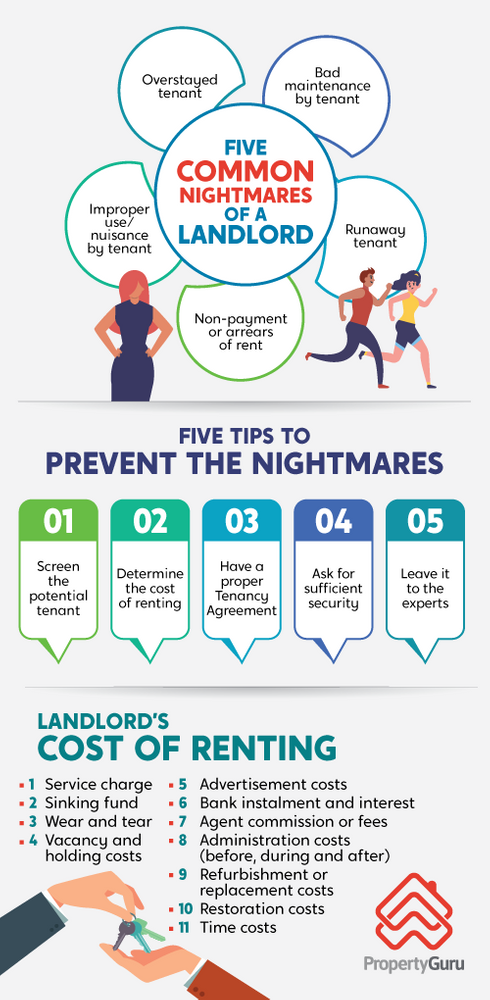
By understanding these realities upfront, you can protect your investment, set fair expectations with tenants, and ensure your experience as a landlord remains both profitable and hassle-free.
Dispute Resolution: What to Do When Things Go Wrong?
Despite all precautions, problems may still arise, such as non-payment of rent, unauthorised subletting, property damage, or disagreements over the return of the deposit.
Here’s how to handle it:
- Check the tenancy agreement first; it should outline the dispute-resolution mechanism.
- Gather documentation: signed tenancy agreement, photos/inventory, communication records (WhatsApp/email), rent payment records, and notices given.
- Issue a formal demand: This gives the tenant a chance to remedy the breach (for example, by paying the outstanding rent within a set period).
- Court proceedings, if needed: To regain possession or recover rent, you may need to apply to the court, as an informal eviction (such as changing locks or locking out the tenant) may expose you to legal risk.
- Hand-back procedure: At the end of tenancy, perform a joint inspection, compare the condition to the inventory, deduct only proven damage, and refund the remaining deposit promptly as per the agreement.
PropertyGuru Tip: Include a dispute-resolution clause in your tenancy agreement so both you and your tenant know what will happen if issues arise.
What’s Changing in 2026: Proposed Laws & Market Trends
Malaysia’s rental sector is on the brink of reform, with new policies and shifting market dynamics reshaping landlord-tenant interactions.
As the government continues fine-tuning its housing agenda, these upcoming changes signal a more structured and transparent rental environment.
Tenancy law reform: A closer look
Malaysia’s rental market has undergone a significant transformation, attracting increased regulatory attention. Key developments to note:
- Recent research by the Khazanah Research Institute highlights the need for a dedicated rentals law to provide tenure security and protect both landlords and tenants in urban settings.
- The proposed Residential Tenancy Act (RTA) or a similar framework is intended to standardise tenancy agreements, create a simpler dispute tribunal, and clarify rights regarding subletting, entry, deposit returns, and rent reviews.
- Although full legislation has not been finalised as of 2026, industry commentary suggests that landlords should prepare now for mandatory written agreements, more explicit deposit rules, and stricter repair/maintenance standards.
These measures are expected to bring long-awaited structure to the rental market, ensuring greater accountability while promoting long-term confidence in the landlord-tenant relationship.
What does this mean for landlords?
For property owners, these changes represent both an adjustment and an opportunity. Staying proactive will be key to navigating this evolving framework effectively.
- You should review and update your tenancy agreement to reflect best practice ahead of reform. "First mover" landlords will find themselves better placed.
- Expect possible standardisation of security deposit handling and refund timelines.
- Consider how you will handle rent reviews, subletting permissions and inspection clauses if the law changes.
- Market trends: Malaysia’s property transaction volume in 2024 reached a decade high, and this momentum is expected to continue.
Landlords who act early will likely find the transition smoother and benefit from greater tenant trust, stronger compliance, and potentially higher occupancy rates.
As 2026 unfolds, both the legal and market landscapes point to a more professionalised rental sector, one in which transparency and preparedness will define successful ownership.
Practical Tips for Landlords in 2026
Managing a rental property in 2026 requires more than just collecting rent; it’s about maintaining transparency, compliance, and long-term tenant relationships in an evolving legal landscape.
The following practices can help landlords stay ahead and operate more efficiently:
- Use a digital contract system: Many platforms now offer e-signatures and photo records of property conditions, which can be very helpful ahead of more formalised tenancy laws.
- Document everything: From inventory lists to messages and payment records, good documentation makes disputes easier to manage.
- Set a regular inspection schedule (with prior notice) to identify issues early, especially in multi-story or high-rise buildings where defects can escalate quickly.
- Have an explicit rent review clause: Tie rent increases to market data or CPI rather than ad-hoc hikes, and give sufficient notice.
- Clarify subletting/short-term rental rules: Many strata schemes now impose restrictions on platforms such as short-term rentals; check your building’s bylaws for details.
- Stay informed about legislation: As reforms progress, keep up with changes via official sources and adjust your agreement templates accordingly.
Adopting these measures not only safeguards your investment but also enhances tenant trust, a balance that defines successful property management in 2026.
Next Steps for You in 2026
As a landlord, you stand at the cusp of change. While the current legal framework continues to rely heavily on contract law and discrete pieces of legislation, reform is imminent.
By proactively updating your tenancy agreement, thoroughly documenting your processes, respecting your tenant’s rights, and staying compliant, you position yourself not only to protect your investment but also to attract and retain quality tenants.
If you’re ready to list your property, get started by exploring the latest listings and tools available on the PropertyGuru Malaysia platform.
Keep Track of New Launches
Visit our new launches page to find the new launch project of your dreams and submit an enquiry today.

Disclaimer: The information is provided for general information only. PropertyGuru International (Malaysia) Sdn Bhd makes no representations or warranties in relation to the information, including but not limited to any representation or warranty as to the fitness for any particular purpose of the information to the fullest extent permitted by law. While every effort has been made to ensure that the information provided in this article is accurate, reliable, and complete as of the time of writing, the information provided in this article should not be relied upon to make any financial, investment, real estate or legal decisions. Additionally, the information should not substitute advice from a trained professional who can take into account your personal facts and circumstances, and we accept no liability if you use the information to form decisions.