


Penang’s recent announcement to revise quit rent (cukai tanah) rates from 1st January 2026 has put the spotlight back on one of Malaysia’s most overlooked property obligations. With rates for both urban and rural land set to rise, homeowners and investors across the country are taking a closer look at how this annual land tax works and what they might owe.
Quit rent (Cukai Tanah) is paid to the State Government through the Pejabat Tanah dan Galian (PTG), and while the amount may seem modest, missing payment deadlines can lead to penalties or even land forfeiture under the National Land Code.
As states modernise their systems through e-Tanah and digital payment options, understanding your quit rent obligations is more important than ever. This guide explains current rates, calculations, and the latest updates across Malaysia.
Quit Rent Rates by State in Malaysia
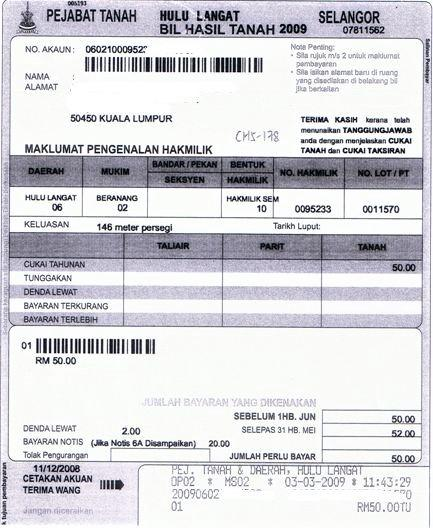
Quit rent rates in Malaysia differ across states, as each State Government determines its own structure based on factors such as land use, classification, and location.
The table below offers the latest verified reference rates for 2025, along with key updates and sources.
| State | Indicative Quit Rent Rate (Residential) |
| Johor | Urban: RM18.00 per 100 sqm (Tanah Bandar Kategori B) Rural: RM10.00 per 100 sqm (Tanah Desa) |
| Kedah | Rates can be checked online using your land title via the PTG Kedah e-Tanah portal |
| Kelantan | Urban (Kota Bharu): RM0.07 per sqm Rural: minimum RM0.02 per sqm |
| Federal Territories (Kuala Lumpur, Putrajaya, Labuan) | Calculated based on title and lot size; check via the JKPTG portal |
| Melaka | Urban: RM42.00 per 100 sqm Rural: RM8.40 per 100 sqm (Desa 3) |
| Negeri Sembilan | Rates can be checked online with the title via the PTG Negeri Sembilan portal |
| Pahang | Urban: RM0.70 per sqm (effective 1 Jan 2026); Rural: RM0.50 per sqm |
| Penang | Urban: RM0.70 per sqm (effective 1st January 2026) Rural: RM0.50 per sqm; rebates of 32.5% (2026) and 20% (2027–2028) apply |
| Perak | Taiping: RM0.38 per sqm Pasir Salak: RM0.14 per sqm |
| Perlis | Medium-cost housing: approx. RM150 per year Low-cost housing: approx. RM44 per year |
| Sabah | Rates vary by land category; confirm with Jabatan Tanah dan Ukur Sabah |
| Sarawak | Urban (Grade 1): RM0.12 per sqm Rural: RM0.03 per sqm |
| Selangor | Varies by district and land category; check via e-Tanah Selangor |
| Terengganu | Non-strata: RM6.00 per 100 sqm Strata: RM10.00 per 100 sqm (urban and rural follow similar rates) |
Notes:
- Quit rent rates are indicative and may change periodically based on updates from each State Land Office (Pejabat Tanah dan Galian, PTG).
- The amount payable depends on land tax classification (urban or rural) and property type (landed or strata).
- Some states, such as Selangor and Penang, now provide e-Tanah online services for checking and paying quit rent.
- Always keep your land title (hakmilik) details ready when verifying or paying your quit rent.
- For strata properties, quit rent may be replaced by parcel rent (cukai petak), billed individually to each unit owner instead of through the building management.
Quick Tip
If you’re unsure of your quit rent balance, visit your state’s e-Tanah portal or contact your PTG directly. Many now allow online checks using your lot number or IC number, making the process faster and more transparent.
View the state-by-state breakdown.
Land Tax Rates For 14 States In Malaysia
Who Needs To Pay Quit Rent?
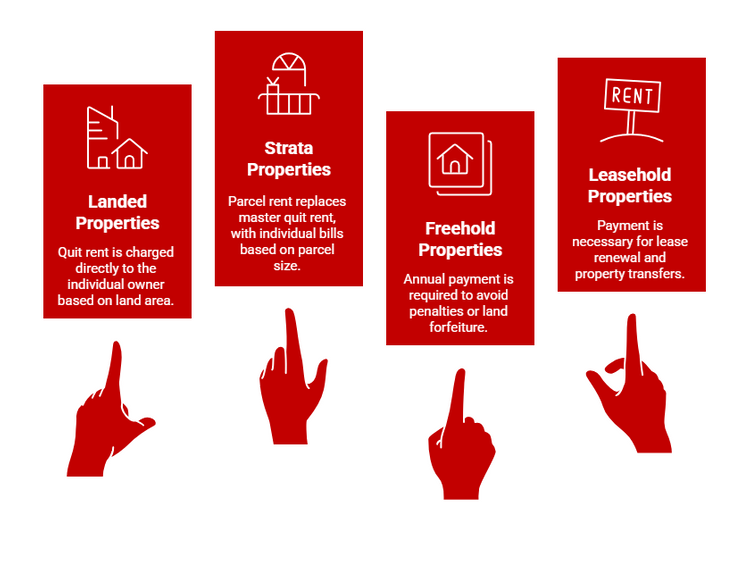
Every registered landowner in Malaysia is required to pay quit rent once a year. This applies to both freehold and leasehold properties that have been officially alienated by the State Government through the Pejabat Tanah dan Galian (PTG).
Landed vs Strata Properties
For landed properties, quit rent is charged directly to the individual owner based on the land area stated in the land title.
For strata properties, such as condominiums or serviced apartments, many states have introduced parcel rent (cukai petak) to replace the older master quit rent system. Each unit owner now receives an individual bill based on the parcel size, instead of the building management paying collectively on behalf of all residents.
Freehold vs Leasehold
Both freehold and leasehold property owners must pay quit rent annually. For leasehold properties, failure to pay may affect lease renewal or property transfers. For freehold properties, long-term non-payment can lead to penalties or, in extreme cases, land forfeiture under the National Land Code (Section 100).
Ownership and Post-Transfer Responsibility
Once the Sale and Purchase Agreement (SPA) is completed and ownership is transferred, the new owner becomes responsible for all future quit rent payments. It is important to check for any outstanding arrears before completing a purchase to avoid unexpected liabilities later.
If your name appears on the land title, you are responsible for paying quit rent. Whether it’s a landed home or a strata unit, keeping your payments up to date protects your ownership rights and ensures smooth future transactions.
Where Do You Pay the Quit Rent (Cukai Tanah)?
You can pay your Quit Rent through several methods, depending on the state where your property is located.
- In person – at your nearest Pejabat Tanah (District Land Office).
- Online – through the official state e-Tanah or Land Office portal (if available).
- At Pos Malaysia branches – available in several states, including Negeri Sembilan, Melaka, Wilayah Persekutuan Kuala Lumpur, Selangor, Perak, and Putrajaya.
Below is a detailed list of contact numbers and official websites for all state land offices across Malaysia.
Quit Rent (Cukai Tanah) Payment: State Land Office Directory
Melaka (Malacca)
06 – 333 3333 ext 5048
Available via eBayaran Melaka
Penang (Pulau Pinang)
+604-6505211
Available via eTanah Pulau Pinang
Important Notes
- Always verify your land account number (No. Akaun Cukai Tanah) before making payment.
- Payment methods vary by state; some support FPX online banking, while others may require counter payment or Pos Malaysia.
- Keep your payment receipt or online confirmation as proof for future reference, particularly during ownership transfers.
How is Quit Rent Calculated?
Quit rent is calculated based on the size of your land and the rate set by your State Government. The formula is simple:
Quit Rent = Land Area × State Rate
Quit Rent = Land Area × State Rate
However, the exact amount you pay depends on several factors, including whether your property is located in an
- Urban or rural area,
- The type of land use (residential, agricultural, or industrial),
- And the state your property is in. Each state determines its own rate and may update it from time to time.
For example, if you own a landed house in Johor Bahru with a land area of 300 sqm, and the rate is RM18 per 100 sqm, the calculation would be:
(300 ÷ 100) × RM18 = RM54 per year.
(300 ÷ 100) × RM18 = RM54 per year.
For strata properties such as condominiums or serviced apartments, some states have replaced quit rent with parcel rent (cukai petak), where each owner pays individually based on the size of their unit.
If your unit is 120 sqm and the rate is RM0.70 per sqm, your annual parcel rent would be RM84.
It’s also important to note that some states revise their rates periodically. For example, Penang will increase its quit rent from 1st January 2026, with urban rates rising from RM0.54 per sqm to RM0.70 per sqm and rural rates from RM0.22 per sqm to RM0.50 per sqm.
In short, the larger your land and the higher your state’s rate, the more you’ll need to pay. Always check your exact quit rent amount with your Pejabat Tanah dan Galian (PTG) or through your state’s e-Tanah portal to stay up to date.
What’s The Difference Between Quit Rent And Assessment Tax?
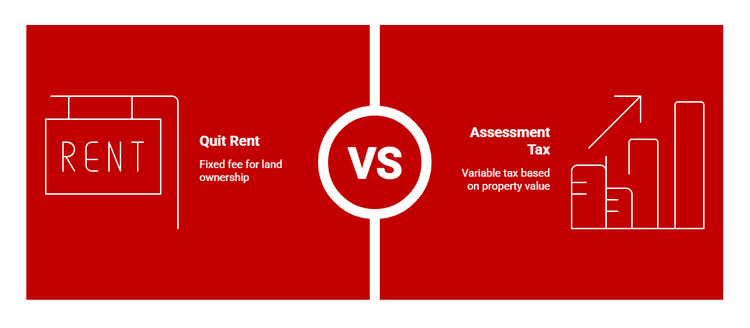
Many Malaysian homeowners tend to mix up quit rent (cukai tanah) with assessment tax (cukai pintu). While both are mandatory annual property-related payments, they are collected by different authorities and serve very different purposes.
Assessment tax (cukai pintu) is a local council tax collected by your Majlis Perbandaran or Majlis Bandaraya. It’s calculated based on the estimated rental value of your property and helps fund local public services.
Here’s a quick comparison to help you understand the difference:
| Quit Rent (Cukai Tanah) | Assessment Tax (Cukai Pintu) |
| State Government via Pejabat Tanah dan Galian (PTG) | Local Council (Majlis Perbandaran / Majlis Bandaraya) |
| Governed by the National Land Code (NLC) | Governed by the Local Government Act 1976 |
| All landowners (freehold and leasehold) | Property occupiers or owners within council areas |
| Right to occupy and use the land | Maintenance of public services such as waste collection, street lighting, drainage, and roads |
| Based on land area and state rate (per sqm) | Based on the annual rental value determined by the local council |
| Once a year (usually between 1 January and 31 May) | Twice a year (every half-yearly cycle) |
| State e-Tanah portal, PTG counters, or Pos Malaysia (in some states) | Local council offices or online portals (e.g., MBPJ, DBKL, MBSA) |
| A landed property in Johor: 300 sqm × RM18/100 sqm = RM54/year | A terrace house in Petaling Jaya with RM2,400 annual rental value = RM240/year (at 10% rate) |
In short, quit rent is tied to land ownership, while assessment tax relates to municipal services. Both payments are equally important for keeping your property legally compliant and ensuring continued access to public amenities.
What Happens If You Don’t Pay Quit Rent?
Not paying your quit rent (cukai tanah) might seem like a small issue, but it can lead to bigger problems later.
- The State Land Office (Pejabat Tanah dan Galian) will first send you a reminder notice if you miss the payment deadline.
- If you still don’t pay, a final notice will be issued, and penalties or late charges may be added to your outstanding amount.
- Unpaid arrears can be recorded on your land title (hakmilik), which may cause issues when you want to sell, transfer, or refinance your property.
- In serious cases where quit rent has gone unpaid for several years, the State Government has the right to forfeit the land under the National Land Code.
- Once forfeited, ownership of the land returns to the State, and reclaiming it can be a long and costly process.
- Even if forfeiture doesn’t happen, you may face delays in legal transactions, additional administrative fees, or interest charges.
Keeping your quit rent up to date shows good ownership responsibility and helps avoid unnecessary legal or financial trouble. It’s always best to check your balance early each year through your state’s e-Tanah portal or by visiting your local Land Office (PTG).
Check your loan eligibility before you buy.
Plan Your Next Property Purchase With Confidence
Stay Compliant And Protect Your Ownership
Owning a property in Malaysia comes with responsibilities, and paying your quit rent (cukai tanah) is one of the most important. Staying up to date ensures compliance with state regulations and maintains the validity of your ownership records.
Before each new year begins, check your quit rent balance through your state’s e-Tanah portal or contact your local Pejabat Tanah dan Galian (PTG). Paying on time helps you avoid penalties and maintain smooth property transactions.
For more tips on property ownership and taxes, visit the PropertyGuru Malaysia Guides Section.
Planning to buy your next property? Start browsing the latest verified sales listings on PropertyGuru Malaysia today!
Disclaimer: The information is provided for general information only. PropertyGuru International (Malaysia) Sdn Bhd makes no representations or warranties in relation to the information, including but not limited to any representation or warranty as to the fitness for any particular purpose of the information to the fullest extent permitted by law. While every effort has been made to ensure that the information provided in this article is accurate, reliable, and complete as of the time of writing, the information provided in this article should not be relied upon to make any financial, investment, real estate or legal decisions. Additionally, the information should not substitute advice from a trained professional who can take into account your personal facts and circumstances, and we accept no liability if you use the information to form decisions.