


Selling a house in Malaysia involves more than finding a buyer and collecting the sale proceeds. From legal documentation to agent commissions and property taxes, several costs come into play before the deal is complete. Understanding these fees upfront helps you set a realistic selling price and avoid surprises during the transaction.
In 2026, with updated guidelines on legal fees and Real Property Gains Tax (RPGT), sellers need to stay informed about what they’ll actually pay. Here’s a detailed look at the essential expenses involved in selling your property in Malaysia this year.
Property Agent Fees and Commission Charges
When you engage a registered estate agent in Malaysia to handle the sale of your house, you’ll need to budget for an agent’s commission and any additional costs associated with marketing and viewings.
- The guiding body, Board of Valuers, Appraisers, Estate Agents & Property Managers (BOVAEP), sets a maximum commission of 3 % of the final selling price for residential property transactions.
- Typical practice is around 2 to 3 %, though negotiation is possible, especially if the property is of higher value or the agent’s scope is limited.
- The agent may charge additional fees for marketing materials, transport or staging; these should be disclosed up-front.
Commission table – Residential property sales (2025 guidance):
Up to RM500,000
2.0 to 3.0 %
3.0 %
RM500,000 to RM1,000,000
2.0 to 3.0 %
3.0 %
Above RM1,000,000
2.0 to 3.0 % (negotiable)
3.0 %
What sellers should check:
- Ensure the agent is registered and licensed under the Estate Agents Act.
- Confirm the commission rate in writing and whether the commission is inclusive or exclusive of SST (Service Sales Tax); typically, SST at 8 % applies on top of the commission.
- Ask whether any minimum fee or fixed “marketing” expense applies in addition to commission.
- Clarify when the fee is due (e.g., on signing of SPA, on transfer, or when funds are received).
Valuation Costs When Selling a Property Without an Agent
Suppose you opt to sell your home without engaging an agent (i.e., “going solo”). In that case, you may still need a professional valuation to set an appropriate price, and there are associated costs.
What you’ll pay for:
- A certified appraiser will determine the market value of your property, providing a credible basis for pricing and helping to mitigate disputes.
- Assessment fees typically depend on the property’s value and the complexity of the appraisal (e.g., a strata unit versus a landed house).
Typical valuation fee guidance:
While there is no statutory fixed scale for all valuations, a typical structure may mirror the guidance previously published:
While there is no statutory fixed scale for all valuations, a typical structure may mirror the guidance previously published:
| Property Value (RM) | Appraisal Fee Rate* |
| Up to RM100,000 | 0.25 % |
| Next portion up to RM2 million | 0.20 % |
| Next portion up to RM7 million | 0.167 % |
Tips for the individual seller:
- Use the valuation report to justify your asking price in your listings.
- Compare similar properties in your locale (recent sales) to determine whether the valuation is accurate.
- Factor in time and cost for marketing and viewings, as you will be handling these yourself.
- If you’re managing the sale yourself, ensure you understand the legal and procedural elements (such as SPA, transfers, etc.) to avoid incurring unexpected costs or delays.
Home Improvement, Repairs, and Cleaning Expenses
Before showing your property to prospective buyers, it’s wise to budget for fixes, refreshes and presentation. A well-maintained home often commands a better price and a faster sale.
Areas to consider spending on:
- Basic repairs: leaking faucets, cracked tiles, creaking doors, chipped countertops.
- Cosmetic refresh: fresh coat of paint, deep cleaning, decluttering, and removing personal items.
- Presentation & staging: consider professional cleaning or light staging to help buyers envision the space.
- Prioritise areas that prospective buyers will notice first (e.g., main living room, kitchen, master bedroom).
Cost-management tips:
- Focus on visible impact rather than major renovations; small investments often yield good returns.
- Keep records and receipts for expenses: if improvements enhance the value and you later sell, some costs may be deductible when calculating taxable gains (see RPGT section).
- Avoid overspending: ensure that the cost of the improvement is proportionate to the property’s expected value and the local market norm.
- Timing matters: ensure repairs are completed promptly before viewings, but avoid undertaking work that is unlikely to influence buyer decisions.
Lawyer Fees for Selling a House in Malaysia
Once a buyer is secured for your property, legal formalities become essential; engaging a solicitor (lawyer) ensures the sale and transfer are appropriately handled. The fee structure is governed under the Solicitors’ Remuneration Order 2023 (SRO 2023), which came into effect on 15 July 2023.
Fee scale (typical for sale/transfer of immovable property):
| Consideration or Adjudicated Value (RM) | Scale Fee (%) |
| First RM500,000 | 1.25 % (minimum RM500) |
| Next RM7,000,000 | 1.00 % |
| Exceeding RM7,500,000 | Negotiable (max 1 %) |
What you need to know:
- These rates apply to non-contentious transactions (typical sales) and are the maximum scale; solicitors may not discount below the prescribed minimums.
- For properties governed under the Housing Development (Control & Licensing) Act 1966 (HDA) (i.e., new developer units), discounted rates apply (Table B of the SRO).
- In the case of selling a house, your solicitor will prepare the Sale & Purchase Agreement (if applicable), handle title transfer, liaise with the land office and coordinate with your buyer’s solicitor.
- Ask for an itemised quote that includes just the legal fees and separately the disbursements (search fees, registration fees, land office costs) so you know exactly what you’ll pay.
- A well-qualified solicitor can ensure all checks (outstanding loans, encumbrances, and correct title) are done, avoiding costly setbacks at the transfer stage.
Real Property Gains Tax (RPGT) in 2026: What Sellers Need to Know
When you sell a property in Malaysia and make a gain (i.e., sale price exceeds acquisition cost plus allowable expenses), you may be liable for Real Property Gains Tax (RPGT). The rules were updated to a self-assessment regime with effect from 1 January 2025.
A. RPGT Filing & Self-Assessment: Latest Rules Effective 2026
- From 2026, sellers (disposers) must compute their own chargeable gain, file the return and pay the tax within specified deadlines.
- The disposal date triggers the clock: usually the date of the written agreement or when transfer occurs.
- The seller must submit the RPGT return (via e-CKHT or MyTax) and pay the tax accordingly; failure may result in penalties (e.g., 10 % late payment surcharge).
- It is vital to keep full documentation: acquisition cost records, improvement receipts, legal/agent fees (for deduction), and sale/settlement paperwork.
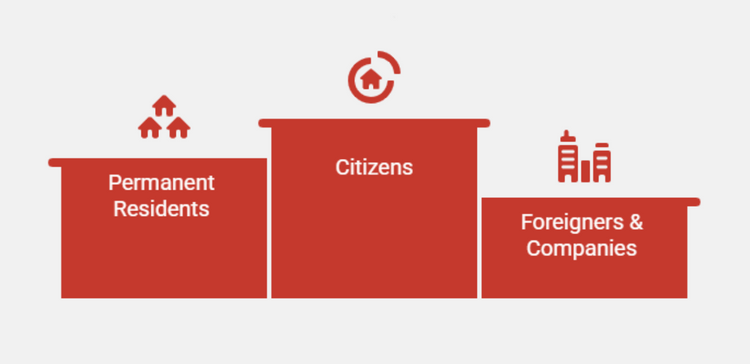
B. Who Needs to Pay RPGT: Citizens, PRs, Foreigners and Companies
Here are the key categories:
Malaysian citizen or Permanent Resident
less than or equal to three years
30 %
Malaysian citizen or Permanent Resident
Fourth year
20 %
Malaysian citizen or Permanent Resident
Fifth year
15 %
Malaysian citizen or Permanent Resident
Sixth year or more
0 %
Foreigner / Non-citizen individual
less than or equal to three years
30 %
Foreigner
Fourth year
30 %
Foreigner
Fifth year
30 %
Foreigner
Sixth year or more
10 %
Company / Trust body
less than or equal to three years
30 %
Company / Trust body
Fourth year
30 %
Company / Trust body
Fifth year
30 %
Company / Trust body
Sixth year or more
10 %
Important notes:
- Even if you are a Malaysian citizen, the holding period is critical: disposing before year 6 means a rate applies.
- If you are a foreigner, no matter how long you hold the property, you cannot reach 0 %; the minimum is 10 %.
- Companies may also be subject to CGT or RPGT depending on their structure (see LHDN guidance).
C. Calculating Chargeable Gains and Deductible Costs
Chargeable Gain = Disposal Price – (Acquisition Price + Allowable Expenses)
Net Taxable Gain = Chargeable Gain – Exemption (for eligible individuals)
Net Taxable Gain = Chargeable Gain – Exemption (for eligible individuals)
Allowable expenses may include:
- Legal fees in connection with acquisition or disposal.
- Agent’s commission (if payable by seller).
- Improvements (capital in nature, not routine maintenance).
- Stamp duty and registration fees paid on acquisition or disposal, where applicable.
- Documentation and transfer costs.
Example (for a Malaysian citizen):
- Acquisition at RM400,000; sale at RM700,000.
- Allowable expenses: RM30,000 (legal + commission + improvements).
- Chargeable Gain = RM700,000 – (RM400,000 + RM30,000) = RM270,000.
- Exemption: greater of RM10,000 or 10% of RM270,000 = RM27,000.
- Net Gain = RM270,000 – RM27,000 = RM243,000.
- Holding period: 5th year → rate 15 %.
- RPGT Payable = RM243,000 × 15 % = RM36,450.
Note: This is an illustrative example only.
Understand RPGT
Learn how to calculate Malaysia’s Real Property Gains Tax
Additional or Hidden Costs When Selling Property in Malaysia
Beyond the main cost items already discussed, several lesser-known or unexpected expenses may arise during a property sale. It’s wise to budget for them and avoid surprises.
Examples of hidden costs:
- Outstanding loan redemption fees (if you still have a mortgage on the property).
- Bank penalties for early settlement or early termination of the loan.
- Updating or rectifying title issues, outstanding utility bills, or strata fees is often required before transfer.
- Costs for discharge of charge, land office registration fees, search fees, and stamp duty on transfer (some part may be borne by the seller if negotiated).
- Marketing costs if you decide to run your own advertising (professional photos, staging, online listings, video walkthroughs).
- Incentives you offer to the buyer (e.g., covering part of the legal fees or transfer duties to accelerate the sale).
- Holding costs if the property remains unsold for an extended period: property tax, utility bills, and maintenance.
Tip: When you prepare your seller-budget, allocate a contingency (say 1 to 2 % of the anticipated sale price) to cover these ancillary costs.
Tips to Reduce Your Selling Expenses
While many costs are unavoidable, you can take steps to reduce or optimise them. Here are practical tips for sellers in 2026:
- Negotiate the agent commission rate, if your property is attractive or you bring your own buyer, you may secure a slightly lower rate than the standard.
- Get at least two or three quotes from valuers and solicitors; competition may help reduce fees.
- Keep repair/improvement costs focused on high-impact, visible areas rather than full-scale renovation.
- Time your disposal to reduce RPGT: if you are a Malaysian citizen and approaching the six year holding mark, delaying may reduce tax from 15 % to 0 %.
- Document all allowable expenses carefully (keep receipts, invoices, digital files) so you can maximise your deduction when calculating RPGT.
- Consider offering to pay part of the buyer’s legal/transfer costs instead of increasing your asking price. This may make your property more appealing while controlling your own costs.
- Use online platforms and social media for marketing (DIY or low-cost) if you’re managing listing yourself; reduce print advertising.
- Where possible, negotiate with your solicitor for fixed fee packages for standard transactions rather than open-ended hourly fees.
Step-by-Step Overview of the Selling Process in Malaysia
Selling a property in Malaysia involves several key stages, each with its own set of fees and administrative steps. Here’s a breakdown of the process and where costs typically apply:
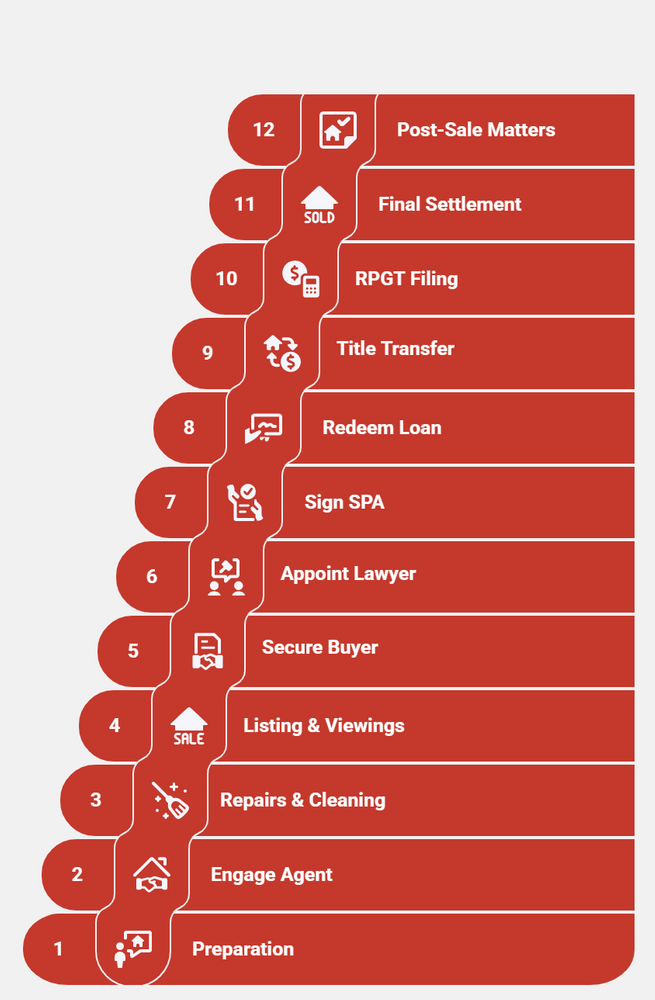
- Preparation and Valuation
Begin by engaging a professional valuer (if you’re managing the sale yourself) or appointing a property agent. This stage may include paying for a valuation report and marketing materials. - Engaging a Property Agent (Optional)
If you choose to work with an agent, you’ll sign a listing agreement that outlines the commission rate, scope of marketing, and duration of the listing. - Pre-Listing Repairs and Cleaning
Address minor defects, repaint, and deep-clean the property to enhance its appeal. Costs here vary depending on the extent of improvement and whether staging services are used. - Listing and Viewings
Advertise the property on reliable platforms and host viewings. You may incur additional costs for professional photography or online listing packages. - Securing a Buyer and Letter of Offer
Once you’ve agreed on a sale price with a buyer, a Letter of Offer is signed. At this stage, the agent’s commission becomes payable as per the agreed terms. - Appointing a Lawyer or Solicitor
Engage a solicitor to handle the Sale and Purchase Agreement (SPA) and conveyancing process. This includes preparing legal documents and ensuring compliance with land office requirements. - Preparing and Signing the SPA
The SPA is drafted, reviewed, and signed by both parties. Your lawyer will coordinate with the buyer’s bank to confirm financing and manage the deposit transaction. - Redeeming Outstanding Loan or Charges
If your property has an existing mortgage, your solicitor will arrange for loan redemption and discharge of the charge. Bank administrative fees may apply. - Title Transfer and Registration
The solicitor facilitates the property title transfer at the Land Office, ensuring all registration and stamp duty fees are settled. - RPGT Filing and Payment
If a profit is made from the sale, file and pay Real Property Gains Tax (RPGT) within the prescribed timeline under the self-assessment system. - Final Settlement and Handover
After all documentation is completed, the buyer’s payment is released. Your solicitor handles disbursement, and you’ll receive the remaining balance after deductions. - Post-Sale Matters
Cancel utility accounts, inform relevant authorities (such as Indah Water and TNB), and settle any outstanding service charges or taxes.
By following this structured process and noting the associated costs at each step, sellers can manage their finances effectively and ensure a smooth, compliant property transaction.
Not sure where to begin? Check out our complete guide to selling a house in Malaysia. It covers every step you need to know.
Disclaimer: The information is provided for general information only. PropertyGuru International (Malaysia) Sdn Bhd makes no representations or warranties in relation to the information, including but not limited to any representation or warranty as to the fitness for any particular purpose of the information to the fullest extent permitted by law. While every effort has been made to ensure that the information provided in this article is accurate, reliable, and complete as of the time of writing, the information provided in this article should not be relied upon to make any financial, investment, real estate or legal decisions. Additionally, the information should not substitute advice from a trained professional who can take into account your personal facts and circumstances, and we accept no liability if you use the information to form decisions.