


Buying vacant land in Malaysia can be an appealing option for those looking to invest or build from the ground up. However, it also involves careful consideration of legal requirements, ownership structures, and state-specific regulations.
Malaysia’s land ownership system has a long legal history that dates back to the colonial era. Over time, several laws were introduced to regulate the transfer and ownership of land. The most significant among them is the National Land Code 1965 (NLC 1965), which standardised land dealings across Peninsular Malaysia. Penang and Malacca are governed by the National Land Code (Penang and Malacca Titles) Act 1963, which operates in a similar manner.
Both systems follow the Torrens system, a form of land registration that identifies the rightful owner of a property through official government records. Understanding this framework is essential before buying land in Malaysia, as it ensures your ownership rights are properly recognised and protected.
What Should You Know About Land Ownership in Malaysia?
Land ownership in Malaysia is governed by a structured legal system that determines who owns the land, how it can be transferred, and what rights come with it. At the core of this system is the Torrens system, which ensures that every piece of land has an officially registered title. This title serves as proof of ownership and provides legal protection against disputes.
Under this system, land transactions must be registered with the relevant Land Office, as only registered owners are recognised by law. This means that even if you have paid for a property, your ownership is not legally valid until it is recorded in the land register.
There are two main types of ownership in Malaysia:
- Freehold land, which grants indefinite ownership and is generally more valuable because it does not expire.
- Leasehold land, which is owned for a fixed period, usually up to 99 years, after which it may need renewal from the state authority.
In addition, certain plots of land are classified under the Malay Reservation Enactment, meaning they can only be owned by Malay individuals or corporations. This restriction is important to check before entering into any purchase agreement, as non-Malays cannot legally acquire such land. Understanding these categories helps you identify your rights, responsibilities, and the long-term potential of the land you plan to buy.
Secure your forever home with a freehold property.
Browse top listings across Malaysia.
What Types of Land Can You Buy?

Before buying land in Malaysia, it is essential to understand how land is categorised, as each type comes with its own rules, restrictions, and potential uses. The main classifications are residential, commercial, agricultural, and vacant land.
1. Residential land
This category is designated for housing purposes, including developments such as terrace houses, condominiums, and apartments. Purchasing residential land often requires approval from the local council before construction can begin, especially for large-scale developments.
This category is designated for housing purposes, including developments such as terrace houses, condominiums, and apartments. Purchasing residential land often requires approval from the local council before construction can begin, especially for large-scale developments.
2. Commercial land
Land marked as commercial is meant for business-related developments such as office buildings, retail outlets, or shopping complexes. These plots are usually located in urban or high-traffic areas and often command a higher market price due to their income-generating potential.
Land marked as commercial is meant for business-related developments such as office buildings, retail outlets, or shopping complexes. These plots are usually located in urban or high-traffic areas and often command a higher market price due to their income-generating potential.
3. Agricultural land
This land is reserved for farming and plantation activities, including crops such as palm oil, rubber, and paddy. If you intend to convert agricultural land for residential or commercial use, you must apply for permission from the relevant state authority and pay a land conversion premium.
This land is reserved for farming and plantation activities, including crops such as palm oil, rubber, and paddy. If you intend to convert agricultural land for residential or commercial use, you must apply for permission from the relevant state authority and pay a land conversion premium.
4. Vacant land
Vacant land refers to plots that are not yet assigned a specific use. This type of land is often more affordable and offers greater flexibility, but it also comes with higher responsibilities. Before purchasing, confirm the land’s zoning, accessibility, and potential for development, as these factors significantly impact its long-term value.
Vacant land refers to plots that are not yet assigned a specific use. This type of land is often more affordable and offers greater flexibility, but it also comes with higher responsibilities. Before purchasing, confirm the land’s zoning, accessibility, and potential for development, as these factors significantly impact its long-term value.
Understanding these classifications helps you align your land purchase with your goals, whether for investment, business, or personal development.
Looking for affordable ownership in prime areas?
Browse Malaysia’s latest leasehold property options.
What Makes Vacant Land a Good Investment?
Vacant land can be a strategic investment if approached carefully. Its appeal often lies in its flexibility, affordability, and potential for long-term gains. The following table summarises the key advantages and considerations when investing in vacant land in Malaysia:
| Factor | Details |
| Lower Cost | Vacant land is usually cheaper than developed residential, commercial, or industrial plots. This makes it accessible for first-time investors or those looking to diversify their portfolio. |
| Flexibility | Buyers can choose to develop the land for residential, commercial, or mixed-use purposes, subject to state approval and zoning regulations. |
| Long-Term Appreciation | Undeveloped land in growing areas can appreciate significantly over time, especially if infrastructure projects or urban expansion occur nearby. |
| Customisation Potential | Investors can design projects from scratch, whether building a private residence, commercial property, or specialised development like a recreational facility. |
| Lower Maintenance Costs | Unlike developed properties, vacant land does not require ongoing maintenance, renovation, or property management fees. |
| Risks to Consider | Returns may take longer to materialise, zoning or development approvals may be complex, and some plots may have accessibility or utility limitations. |
Investing in vacant land can offer high rewards, but it requires careful research, planning, and understanding of local regulations to ensure the investment meets your long-term objectives.
How Can You Check and Survey the Land?
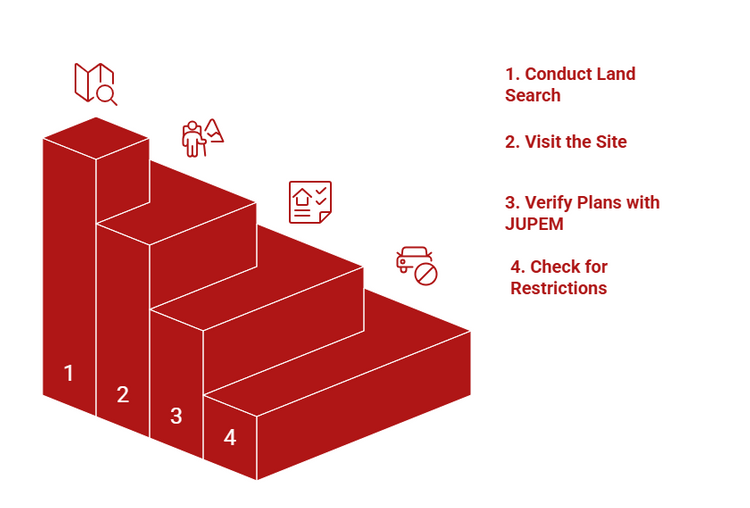
Before purchasing any vacant land, it is essential to verify its boundaries, ownership, and legal status to avoid potential future disputes. A thorough land check and survey ensure you know exactly what you are purchasing.
1. Conduct a Land Search
Start by checking the land’s title and ownership details at the relevant Land Office. This confirms the legal owner, land type, and any restrictions or encumbrances attached to the property.
Start by checking the land’s title and ownership details at the relevant Land Office. This confirms the legal owner, land type, and any restrictions or encumbrances attached to the property.
2. Visit the Site
A personal visit helps you assess the land’s location, accessibility, terrain, and surroundings. Observing the site firsthand can reveal practical issues such as flooding risk, slope stability, or proximity to essential services.
A personal visit helps you assess the land’s location, accessibility, terrain, and surroundings. Observing the site firsthand can reveal practical issues such as flooding risk, slope stability, or proximity to essential services.
3. Verify Plans With JUPEM
The Department of Surveying and Mapping Malaysia (JUPEM) provides certified land plans that clearly define boundaries, measurements, and coordinates. Obtaining a certified plan ensures the land plot is accurately documented and recognised by authorities.
The Department of Surveying and Mapping Malaysia (JUPEM) provides certified land plans that clearly define boundaries, measurements, and coordinates. Obtaining a certified plan ensures the land plot is accurately documented and recognised by authorities.
4. Check For Restrictions or Existing Approvals
Review local council or state authority records to identify any planning permissions, easements, or building restrictions. Ensuring these factors are clear avoids legal complications during development.
Review local council or state authority records to identify any planning permissions, easements, or building restrictions. Ensuring these factors are clear avoids legal complications during development.
By completing these steps, you protect your investment and gain confidence that the land is suitable for your intended purpose.
How Do You Apply for Land Conversion or Change of Use?

Converting vacant land to a different use, such as residential or commercial, is a critical step that can significantly increase the land’s value. In Malaysia, land conversion is regulated on a state-by-state basis, and approval must be obtained from the relevant authorities before development.
1. Check the Current Land Zoning
Before applying, confirm the land’s current zoning with the state land office or local planning authority. Understanding its existing designation helps you determine whether conversion is possible and what category of use is permitted.
Before applying, confirm the land’s current zoning with the state land office or local planning authority. Understanding its existing designation helps you determine whether conversion is possible and what category of use is permitted.
2. Submit a Conversion Application
You must submit a formal application for land conversion or change of use to the state authority. The application typically includes:
You must submit a formal application for land conversion or change of use to the state authority. The application typically includes:
- Certified land title
- Survey plan of the land
- Proposed development plans
- Payment of the applicable conversion fees
3. Pay Land Conversion Premiums
State authorities may require a land conversion premium, which is a fee calculated based on the land’s size and proposed new use. This premium varies depending on the state and land type.
State authorities may require a land conversion premium, which is a fee calculated based on the land’s size and proposed new use. This premium varies depending on the state and land type.
4. Obtain Official Approval
Once the application and payment are reviewed, the authority may grant approval, often including specific conditions or restrictions. Only after this approval can the land be legally developed according to the new use.
Once the application and payment are reviewed, the authority may grant approval, often including specific conditions or restrictions. Only after this approval can the land be legally developed according to the new use.
5. Update the Land Title
After approval, ensure the land title is updated to reflect the new designation. This final step is essential to secure your legal rights and facilitate future transactions.
After approval, ensure the land title is updated to reflect the new designation. This final step is essential to secure your legal rights and facilitate future transactions.
Properly managing the land conversion process ensures compliance with regulations and maximises the investment potential of your vacant land.
From city apartments to suburban homes, find what fits you best.
Explore properties for sale across Malaysia.
How Do You Finalise a Land Purchase?
Finalising a land purchase in Malaysia involves several key steps to ensure that ownership is legally recognised and protected.
1. Draft and Sign the Sale and Purchase Agreement (SPA)
The Sale and Purchase Agreement is the main legal document outlining the terms of the transaction, including the purchase price, payment schedule, and any conditions agreed upon by both parties. It is advisable to engage a qualified lawyer to draft or review the SPA to ensure all legal requirements are met.
The Sale and Purchase Agreement is the main legal document outlining the terms of the transaction, including the purchase price, payment schedule, and any conditions agreed upon by both parties. It is advisable to engage a qualified lawyer to draft or review the SPA to ensure all legal requirements are met.
2. Pay the Deposit and Fees
Typically, a deposit of 10% of the purchase price is paid upon signing the SPA. Additional fees may include legal fees, stamp duty, and administrative charges associated with the transfer process.
Typically, a deposit of 10% of the purchase price is paid upon signing the SPA. Additional fees may include legal fees, stamp duty, and administrative charges associated with the transfer process.
3. Conduct Title and Land Checks
Before completing the purchase, verify that the land title is clear and that there are no encumbrances, disputes, or restrictions that could affect ownership. This step protects you from potential legal complications.
Before completing the purchase, verify that the land title is clear and that there are no encumbrances, disputes, or restrictions that could affect ownership. This step protects you from potential legal complications.
4. Submit Transfer Documents to the Land Office
The final ownership transfer is completed by submitting the land transfer documents to the relevant Land Office. Once processed, the Land Title is updated to reflect your ownership, officially registering you as the new owner.
The final ownership transfer is completed by submitting the land transfer documents to the relevant Land Office. Once processed, the Land Title is updated to reflect your ownership, officially registering you as the new owner.
5. Collect the Land Title
Receiving the updated Land Title confirms that the transaction is legally recognised. Keep this document safely, as it is the most essential proof of ownership and will be required for any future dealings with the property.
Receiving the updated Land Title confirms that the transaction is legally recognised. Keep this document safely, as it is the most essential proof of ownership and will be required for any future dealings with the property.
Completing these steps carefully ensures that your land purchase is legally sound and that your rights as the new owner are fully protected.
What Is the Difference Between Home and Land Financing?
Here is a comparison table summarising the key differences between home financing and land financing in Malaysia for 2026:
Margin of Financing (MOF)/LTV
Up to 90% (with MRTA/MLTA), usually 80 to 90%
Lower MOF, typically 65% to 85% depending on land type
Interest/Profit Rate
Generally lower rates (e.g., from 2.88% p.a. upwards)
Slightly higher rates due to higher risk
Loan Tenure
Longer tenure, up to 35 years or borrower age 70
Shorter tenure, generally up to 20-25 years
Purpose/Asset Profile
For residential property purchase or construction
For undeveloped/agricultural/commercial land purchase
Approval Criteria
More lenient, with government housing support programs
Stricter financial assessment due to risk
Risks
Lower risk due to property liquidity and government backing
Higher risk; land less liquid and speculative
What Documents and Legal Fees Should You Prepare?
For property financing to buy land in Malaysia 2026, here are the typical documents you should prepare and the expected legal fees:
| Documents Needed | Description |
| Identity Card (MyKad) or Passport | Identification proof for Malaysians and foreigners respectively |
| Latest Salary Slips (three to six months) | Proof of income |
| EPF Statement and Income Tax Returns | Financial background verification documents |
| Bank Statements (three to six months) | To show financial stability and cash flow |
| Letter of Employment (if applicable) | Employer’s confirmation of employment status |
| Sales and Purchase Agreement (SPA) | Signed contract between buyer and seller/developer |
| Loan Agreement | Details loan terms, signed after loan approval |
| Valuation Report (for resale properties) | Prepared by a licensed valuer specifying property market value |
| Legal Documents for Title Transfer | Including Form 14A and other Land Office documents |
| Mortgage Insurance (MRTA/MRTT) (optional) | Protects borrower and lender on loan repayment |
| Legal Fees and Costs | Typical Range/Description |
| Legal Fees & Disbursement Fees | Approximately 2% to 3% of the property purchase price |
| Stamp Duty on Loan Agreement | 0.5% of the loan amount |
| Valuation Fees | Approx. 0.25% of property price (mainly for resale transactions) |
| Mortgage Reducing Term Assurance (MRTA/MLTA) | Optional insurance based on loan amount and tenure |
| Other Expenses | Utilities, maintenance fees, and miscellaneous administrative fees (if applicable) |
What Are the Common Mistakes to Avoid When Buying Land?

Investing in land can be rewarding, but mistakes during the purchase process can lead to costly problems. Here are some common pitfalls to avoid when buying land in Malaysia:
1. Failing to Verify the Land Title
Always check the Issue Document of Title at the Land Office to ensure the seller is the legal owner. Purchasing land without confirming ownership can lead to disputes or even fraud.
Always check the Issue Document of Title at the Land Office to ensure the seller is the legal owner. Purchasing land without confirming ownership can lead to disputes or even fraud.
2. Ignoring Land Zoning and Restrictions
Some plots are subject to zoning regulations, Malay Reserve restrictions, or development limitations. Failing to verify permitted land use can prevent you from developing the land as intended.
Some plots are subject to zoning regulations, Malay Reserve restrictions, or development limitations. Failing to verify permitted land use can prevent you from developing the land as intended.
3. Skipping a Proper Land Survey
Boundaries, measurements, and corner markers should be verified through a professional survey or JUPEM certified plan. Buying land without a clear survey can result in disputes with neighbouring properties.
Boundaries, measurements, and corner markers should be verified through a professional survey or JUPEM certified plan. Buying land without a clear survey can result in disputes with neighbouring properties.
4. Underestimating Conversion or Development Costs
Vacant land may require conversion approvals and associated premiums before it can be used for residential or commercial purposes. Not budgeting for these costs can affect your investment returns.
Vacant land may require conversion approvals and associated premiums before it can be used for residential or commercial purposes. Not budgeting for these costs can affect your investment returns.
5. Not Conducting Site Visits
Photos and online listings are not enough. Visit the land personally to check accessibility, terrain, utilities, and environmental risks.
Photos and online listings are not enough. Visit the land personally to check accessibility, terrain, utilities, and environmental risks.
6. Relying on Informal Agreements
Always use a formal Sale and Purchase Agreement (SPA) and engage a qualified lawyer. Verbal agreements or informal documents can leave you unprotected legally.
Always use a formal Sale and Purchase Agreement (SPA) and engage a qualified lawyer. Verbal agreements or informal documents can leave you unprotected legally.
By avoiding these mistakes, you can make a safer, more informed investment and ensure that your land purchase aligns with your long-term goals.
Keep Track of New Launches
Visit our new launches page to find the new launch project of your dreams and submit an enquiry today.

Disclaimer: The information is provided for general information only. PropertyGuru International (Malaysia) Sdn Bhd makes no representations or warranties in relation to the information, including but not limited to any representation or warranty as to the fitness for any particular purpose of the information to the fullest extent permitted by law. While every effort has been made to ensure that the information provided in this article is accurate, reliable, and complete as of the time of writing, the information provided in this article should not be relied upon to make any financial, investment, real estate or legal decisions. Additionally, the information should not substitute advice from a trained professional who can take into account your personal facts and circumstances, and we accept no liability if you use the information to form decisions.