The federal government should increase the required amount of green spaces in new property projects, said architect Alan Teh in a report by Free Malaysia Today.
At present, the authorities impose a green ratio requirement of 10 percent. This means for every space built for residential or commercial purposes, one-tenth must be set aside for eco-friendly premises.
This is the prevailing rule in Kuala Lumpur, Shah Alam, Klang and Subang Jaya.
He revealed that green spaces consist of ‘softscapes’ like trees, landscapes, gardens and parks, while ‘hardscapes’ comprise tiles or walkways where people could jog and do other types of exercises.
He thinks it would not be hard for developers to provide green premises in their projects. Even in urban area where space is limited, these companies can put up roof gardens and vertical green walls. To minimise cost, Teh advised them to do away with expensive materials like marble.
Moreover, he pointed out that Malaysia’s weather is conducive to the growth of flora. “We have the perfect conditions for tropical plants to grow easily and we have access to a wide variety of trees and plants suited for our weather.”
“In countries like Japan, they have to cover the trees during winter to protect them from the cold, and this shows how much they value greenery.”
To encourage developers to provide more eco spaces, he suggested giving more tax incentives to owners of green certified buildings. Currently, the authorities give investment tax allowance to firms that utilise eco-friendly technologies in buildings and transportation.
“I believe that the government should increase the green ratio for buildings and preferably benchmark our guidelines to that of other developed countries,” said Teh.
For instance, all new public buildings in neighbouring Singapore must be green-certified. Despite this rule, he noted that many structures in the country were able to achieve this, including public housing, and some even accomplished a green ratio of 100 percent.
Furthermore, developers can make use of eco-friendly materials with low carbon footprint when constructing their buildings, such as bamboo, mycelium and grasscrete.
The latter consists of concrete or bricks incorporated with grass fibres, while mycelium comprises fungi roots, which are highly durable and can withstand high temperatures.
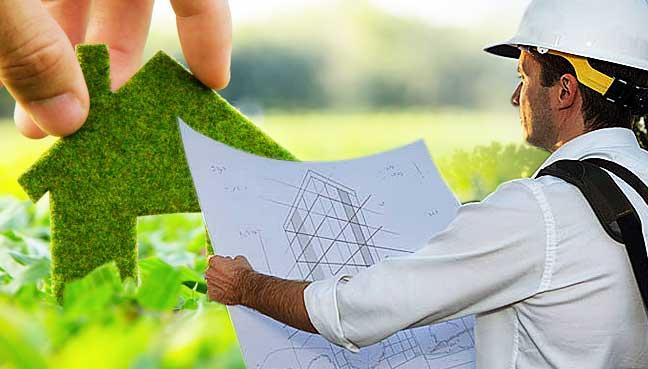
Image sourced from FMT
This article was edited by the editorial team of PropertyGuru. To contact them about this or other stories email Editorial-MY@propertyguru.com.my
For more information on new top homes, check out PropertyGuru’s New Property Launches and Project Reviews